News

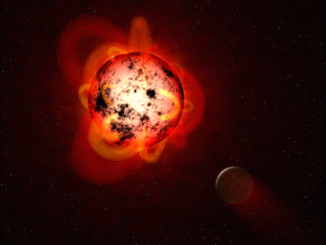
Mini-flares potentially jeopardise habitability of planets circling red dwarf stars

Cool dwarf stars are hot targets for exoplanet hunting right now. The discoveries of planets in the habitable zones of the TRAPPIST-1 and LHS 1140 systems, for example, suggest that Earth-sized worlds might circle billions of red dwarf stars, the most common type of star in our galaxy. But, like our own sun, many of these stars erupt with intense flares. Are red dwarfs really as friendly to life as they appear, or do these flares make the surfaces of any orbiting planets inhospitable?
News

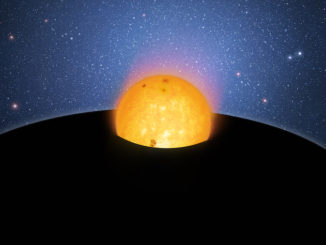
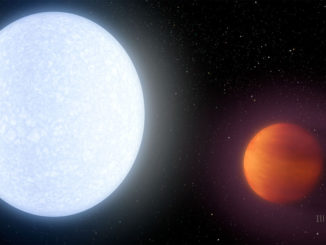
Astronomers find planet hotter than most stars

A newly discovered Jupiter-like world is so hot, it’s being vaporized by its own star. With a dayside temperature of more than 7,800 degrees Fahrenheit, KELT-9b is a planet that is hotter than most stars. But its blue A-type star, called KELT-9, is even hotter — in fact, it is probably unraveling the planet through evaporation.

News

Do stars fall quietly into black holes?

Astronomers at the University of Texas at Austin and Harvard University have put a basic principle of black holes to the test, showing that matter completely vanishes when pulled in. Their results constitute another successful test for Albert Einstein’s general theory of relativity.

News

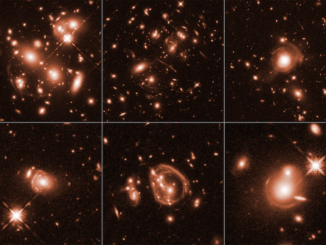
Newly discovered fast-growing galaxies could solve cosmic riddle

Astronomers have discovered a new kind of galaxy in the early universe, less than a billion years after the Big Bang. These galaxies are forming stars more than a hundred times faster than our own Milky Way. The discovery could explain an earlier finding: a population of surprisingly massive galaxies at a time 1.5 billion years after the Big Bang, which would require such hyper-productive precursors to grow their hundreds of billions of stars.

News

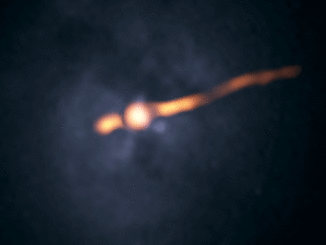
VLA reveals new object near supermassive black hole in famous galaxy

Pointing the Very Large Array at a famous galaxy for the first time in two decades, a team of astronomers got a big surprise, finding that a bright new object had appeared near the galaxy’s core. The object, the scientists concluded, is either a very rare type of supernova explosion or, more likely, an outburst from a second supermassive black hole closely orbiting the galaxy’s primary, central supermassive black hole.

News

Icy ring around Fomalhaut observed in new wavelength

An international team of astronomers using the Atacama Large Millimeter/submillimeter Array has made the first complete millimeter-wavelength image of the ring of dusty debris surrounding the young star Fomalhaut. This remarkably well-defined band of rubble and gas is likely the result of exocomets smashing together near the outer edges of a planetary system 25 light-years from Earth.

News

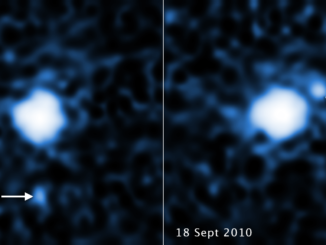
Hubble spots moon around third largest dwarf planet

The combined power of three space observatories, including NASA’s Hubble Space Telescope, has helped astronomers uncover a moon orbiting the third largest dwarf planet, catalogued as 2007 OR10. The pair resides in the frigid outskirts of our solar system called the Kuiper Belt, a realm of icy debris left over from our solar system’s formation 4.6 billion years ago.