Picture This

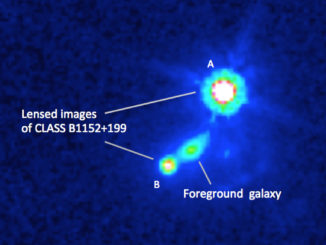
With the help of a gigantic cosmic lens, astronomers have measured the magnetic field of a galaxy nearly five billion light-years away. The achievement is giving them important new clues about a problem at the frontiers of cosmology — the nature and origin of the magnetic fields that play an important role in how galaxies develop over time.
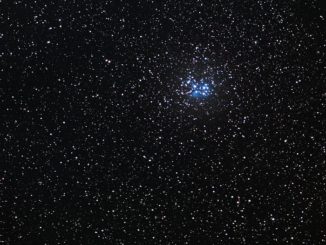
The Seven Sisters, as they were known to the ancient Greeks, are now known to modern astronomers as the Pleiades star cluster – a set of stars which are visible to the naked eye and have been studied for thousands of years by cultures all over the world. A new algorithm to analyse data from NASA’s Kepler telescope has revealed insights about the behaviour of the stars.
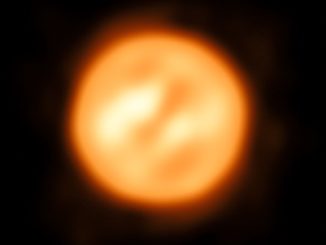
Using ESO’s Very Large Telescope Interferometer astronomers have constructed the most detailed image ever of a star — the red supergiant star Antares. They have also made the first map of the velocities of material in the atmosphere of a star other than the Sun, revealing unexpected turbulence in Antares’s huge extended atmosphere.
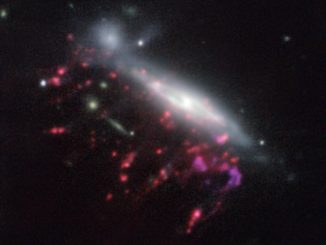
Observations of “Jellyfish galaxies” with ESO’s Very Large Telescope have revealed a previously unknown way to fuel supermassive black holes. It seems the mechanism that produces the tentacles of gas and newborn stars that give these galaxies their nickname also makes it possible for the gas to reach the central regions of the galaxies, feeding the black hole that lurks in each of them and causing it to shine brilliantly.
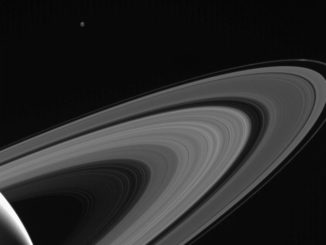

While surveying the positions of over a billion stars, ESA’s Gaia mission is also measuring their colour, a key diagnostic to study the physical properties of stars. A new image provides a preview of Gaia’s first full-colour all-sky map, which will be unleashed in its highest resolution with the next data release in 2018.

Dim objects called brown dwarfs, less massive than the Sun but more massive than Jupiter, have powerful winds and clouds — specifically, hot patchy clouds made of iron droplets and silicate dust. Scientists recently realised these giant clouds can move and thicken or thin surprisingly rapidly, in less than an Earth day, but did not understand why.

Scientists now have a good estimate for the age of one of the most intriguing planetary systems discovered to date — TRAPPIST-1, a system of seven Earth-size worlds orbiting an ultra-cool dwarf star about 40 light-years away. Researchers say in a new study that the TRAPPIST-1 star is quite old: between 5.4 and 9.8 billion years. This is up to twice as old as our own Solar System, which formed some 4.5 billion years ago.
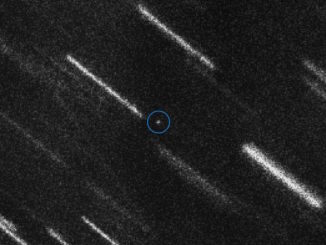
Back in October 2012, the near-Earth asteroid 2012 TC4 had a close encounter with Earth. It passed our planet at a distance only a quarter of that between the Earth and the Moon. In October 2017, this small asteroid, with a size of only about 15 to 30 metres, will return for another very close fly-by, making it the perfect object to test the asteroid detection and tracking network.
© 2019 Pole Star Publications Limited