Picture This

Sparkling Stephan’s Quintet

The Stephan’s Quintet of galaxies in the constellation Pegasus was discovered by astronomer Édouard Stephan in 1877. This image combines observations performed at three different wavelengths, with ESA’s Herschel and XMM-Newton space observatories as well as with ground-based telescopes, to reveal the different components of the five galaxies.
News

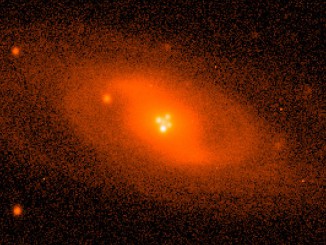
Einstein’s Cross under the gravitational microlens

A team of Spanish astrophysicists has obtained precise measurements for the innermost region of a disc of matter in orbital motion around a supermassive black hole in the lensed quasar known as Einstein’s Cross (Q2237-0305). It constitutes the most precise set of measurements achieved to date for such a small and distant object.

News

Cassini completes final close flyby of Saturn’s moon Enceladus

NASA’s Cassini spacecraft has begun transmitting data and images from the mission’s 22nd and final close flyby of Saturn’s active moon Enceladus on Saturday, 19 December. Cassini has made so many breathtaking discoveries about this icy moon, its geologic activity and global ocean that lies beneath its icy crust, yet so much more remains to be done to determine if this tiny ocean world could harbour life.

Picture This

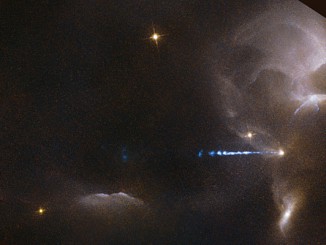
Hubble captures infant star’s artistic outburst

The artistic outburst of an extremely young star, in the earliest phase of formation, is captured in this spectacular image from the NASA/ESA Hubble Space Telescope. The colourful wisps, found in the lower left of the image, are painted onto the sky by a young star cocooned in the partially illuminated cloud of obscuring dust seen to the upper right.

News

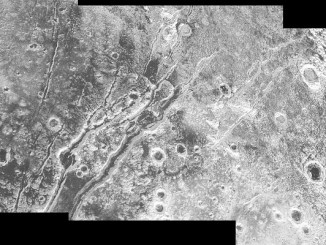
New findings on Pluto and its moons from New Horizons

Five months after NASA’s New Horizons spacecraft flew past Pluto, knowledge about this distant system continues to unfold, yet the spacecraft is less than halfway through transmitting data about the Pluto system to Earth. New Horizons science team members presented the latest findings at the American Geophysical Union (AGU) autumn meeting in San Francisco.

News

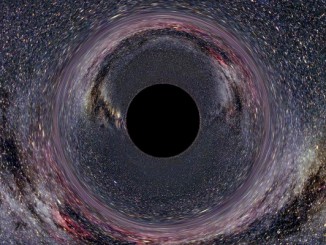
How big can a black hole grow?

Black holes at the heart of galaxies could swell to 50 billion times the mass of the Sun before losing the discs of gas they rely on to sustain themselves, according to research conducted by Professor Andrew King from the University of Leicester’s Department of Physics and Astronomy.

News

Did the ancient Egyptians record the period of eclipsing binary Algol?

A scholarly investigation of the Cairo Calendar papyrus (1244–1163 B.C.) has led researchers at the University of Helsinki to conclude that the ancient Egyptians were aware that the variable star Algol (beta Persei) had a 2.85-day period. Given that the star’s current period is 2.8673 days, this supports the theory that mass transfer between the stars of this eclipsing binary has caused a long-term increase of its orbital period.