Equipment

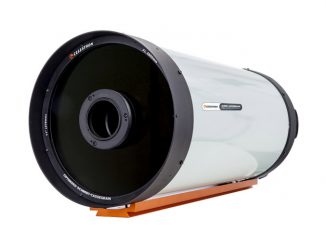
Celestron Rowe-Ackermann Schmidt Astrograph

Celestron’s 280mm (11-inch) aperture f/2.2 Rowe-Ackermann Schmidt Astrograph (RASA) is capable of blisteringly fast photographic speeds, capturing images of nebulae and galaxies in seconds. An imaging system optimised for virtually any one-shot colour CCD or DSLR in existence, Ade Ashford appraises this photon-grabbing wonder in the context of evolving optical systems.
Picture This

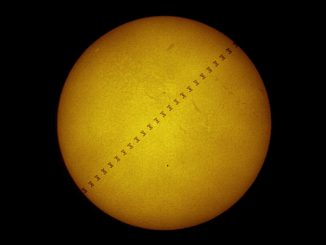
Mercury and International Space Station transit the Sun

French astrophotographer Thierry Legault travelled to the suburbs of Philadelphia, USA to capture both the International Space Station and planet Mercury transiting the Sun on 9 May. This image includes multiple stacked frames to show the Station’s path in the fraction of a second it took to cross the Sun, while Mercury appears as a black dot at bottom-centre.

News

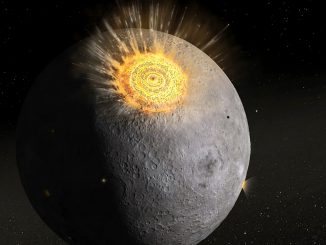
Asteroids identified as source of Moon’s water

According to a new international study, most (>80 percent) of the water inside the Moon was delivered by asteroids similar to carbonaceous chondritic meteorites during the early lunar evolution, approximately 4.5—4.3 billion years ago. A similar delivery of water to the Earth would have been occurring within this same interval of time.

News

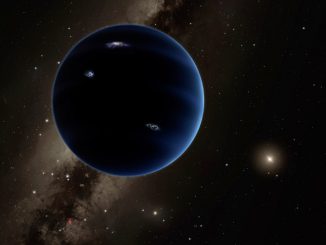
Did the young Sun steal Planet 9 from another star?

Through a computer-simulated study, astronomers at Lund University in Sweden show that it is highly likely the so-called Planet 9 is an exoplanet. This would make it the first such body to be discovered inside our own solar system — when or if it is found. The theory is that our Sun, in its youth some 4.5 billion years ago, stole Planet 9 from its original star.

Picture This

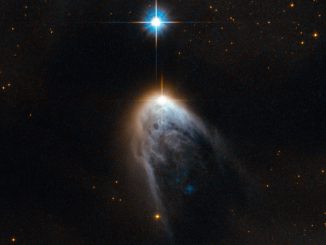
A golden veil cloaks a newborn star

In this NASA/ESA Hubble Space Telescope image, we see a young star breaking out. The golden veil of light cloaks a young stellar object known only as IRAS 14568-6304 in the Circinus molecular cloud complex. This stellar newborn is ejecting gas at supersonic speeds and eventually will have cleared a hole in the cloud, allowing it to be easily visible to the outside universe.

Picture This

Hubble views heavy-metal stars

This 10.5-billion-year-old globular cluster, NGC 6496, is home to heavy-metal stars of a celestial kind! The stars comprising this spectacular spherical cluster are enriched with much higher proportions of metals (in astronomy, elements heavier than hydrogen and helium are curiously known as metals) than stars found in similar clusters.

Observing

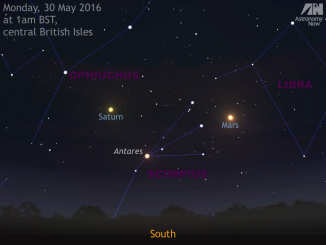
See Mars at its closest for over a decade and Saturn at opposition

On the evening of Monday, 30 May, Mars is closer to Earth than at any time since 30 October 2005. This begs the question: just how close can Mars get? Ade Ashford gives you an overview of close Martian oppositions past, present and future. Also, Friday, 3 June sees the opposition of Saturn, the other planet visible low in the south around midnight.

Picture This

New Horizons’ best close-up of Pluto’s surface

A mosaic strip just released by the New Horizons team now includes all of the highest-resolution images taken by the NASA probe. The mosaic affords scientists and the public the best opportunity to examine the fine details of the various types of terrain on Pluto, and determine the processes that formed and shaped them.

News

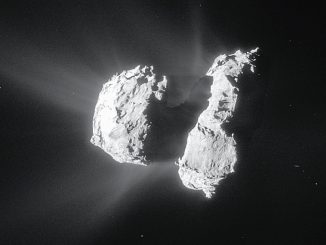
Rosetta’s Comet 67P contains ingredients for life

The possibility that water and organic molecules were brought to the early Earth through cometary impacts has long been the subject of important debate. Now, ingredients crucial for the origin of life on Earth, including the simple amino acid glycine and phosphorus — key components of DNA and cell membranes — have been discovered at Comet 67P/Churyumov-Gerasimenko.

News

Astronomers find giant planet around very young star CI Tauri

Contradicting the long-standing idea that large Jupiter-mass planets take a minimum of 10 million years to form, astronomers have just announced the discovery of a giant planet in close orbit around a 2 million-year-old star that still retains a disc of circumstellar gas and dust. CI Tau b is at least eight times larger than Jupiter and 450 light-years from Earth.