
Video


Observers up for an extreme observing challenge may care to make an attempt at viewing the almost full Moon pass in front of planet Neptune soon after 8pm BST on Thursday, 15 September. The planet’s disappearance occurs at a low altitude in twilight for the British Isles, but can also be seen from a large swathe of Europe and western Russia.

Saturn’s shadow stretched beyond the edge of its rings for many years after the NASA/ESA/ASI Cassini spacecraft first arrived at Saturn, casting an ever-lengthening shadow that reached its maximum extent at the planet’s 2009 equinox. This image captured the moment in 2015 when the shrinking shadow just barely reached across the entire main ring system.
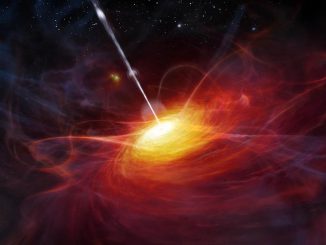
Quasars are supermassive black holes that sit at the centre of enormous galaxies, accreting matter. They shine so brightly that they are among the most distant objects in the universe that we can currently study. New work from a team led by Carnegie’s Eduardo Bañados has discovered 63 new quasars from when the universe was just 7 percent of its present age.

This scene captured by the NASA/ESA Hubble Space Telescope shows PGC 83677, a lenticular galaxy — a galaxy type that sits between the more familiar elliptical and spiral varieties in the Hubble sequence. Studies have uncovered signs of a monstrous black hole in the core of PGC 83677 that is spewing out high-energy X-rays and ultraviolet light.

© 2019 Pole Star Publications Limited