News

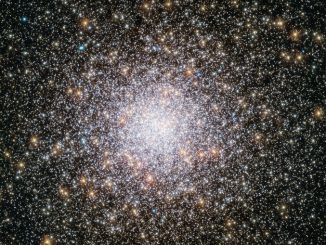
Globular clusters offer some of the most spectacular sights in the night sky. These ornate spheres contain hundreds of thousands of stars, and reside in the outskirts of galaxies. The Milky Way contains over 150 such clusters — and the example shown in this NASA/ESA Hubble Space Telescope image, named NGC 362, is one of the most unusual ones.
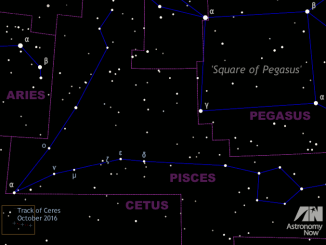
Ceres, the largest minor planet inside the orbit of Neptune, passed closest to Earth on the evening of 22 October — the night of the last quarter Moon. With the lunar crescent now confined to the morning sky, grab your binoculars or telescope, print out some star charts from our online guide and track down the brightest of the dwarf planets while at its best.

A group of citizen scientists and professional astronomers joined forces to discover an unusual hunting ground for exoplanets. They found a red dwarf, called AWI0005x3s, surrounded by the oldest known circumstellar disc — a 45-million-year-old primordial ring of gas and dust orbiting the star from which planets can form.
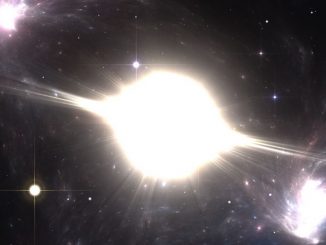
Five years ago, the Nobel Prize in Physics was awarded to three astronomers for their discovery, in the late 1990s, that the universe is expanding at an accelerating pace. Now, a team of scientists led by Professor Subir Sarkar of Oxford University’s Department of Physics has cast doubt on this standard cosmological concept.
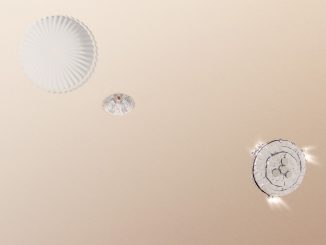

Astronomers have discovered possible evidence for water on the surface of 16 Psyche, the largest metallic asteroid in the solar system. Measuring 186 miles across and consisting of almost pure nickel-iron metal, Psyche is thought to be the remnant core of a planetary embryo that was mostly destroyed by impacts billions of years ago.
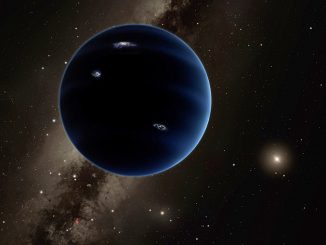
Planet Nine — the undiscovered planet at the edge of the solar system that was predicted by the work of Caltech’s Konstantin Batygin and Mike Brown in January 2016 — appears to be responsible for the unusual tilt of the Sun. The large and distant planet may be adding a wobble to the solar system, giving the appearance that the Sun is tilted slightly.
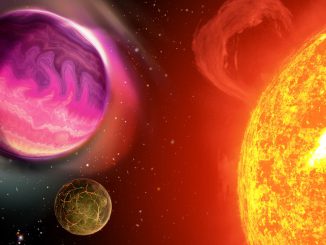
University of Florida astronomers have discovered the first “binary-binary” — two massive companions around one star in a close binary system, one so-called giant planet and one brown dwarf, or “failed star.” For such large companion objects to be stable so close together defies our current popular theories on how solar systems form.
© 2019 Pole Star Publications Limited