News

MESSENGER data reveals great valley on Mercury

Scientists have discovered a 600-mile-long valley on Mercury that may be the first evidence of buckling of the planet’s outer silicate shell in response to global contraction. The researchers discovered the valley using a new high-resolution topographic map of part of Mercury’s southern hemisphere created by stereo images from NASA’s MESSENGER spacecraft.

News

New analysis supports subsurface ocean on Pluto

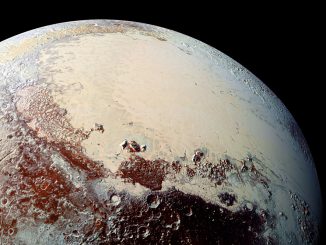
A liquid ocean lying deep beneath Pluto’s frozen surface is the best explanation for features revealed by NASA’s New Horizons spacecraft, according to a new analysis. The idea that Pluto has a subsurface ocean is not new, but the study provides the most detailed investigation yet of its likely role in the evolution of key features such as the vast, low-lying plain known as Sputnik Planitia (formerly Sputnik Planum).

Observing

Leonid meteor shower maximum blighted by the Moon

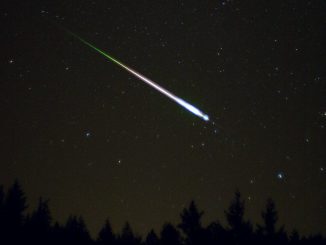
The maximum of the annual Leonid meteor shower, when up to around 15 shooting stars per hour might be expected in a dark sky, is predicted to occur in the small hours of Thursday 17 November for observers in Western Europe and the UK. However, the famously swift, bright Leonids — some with persistent trails — will have to contend with a Moon just three days after full.

News

Flying observatory SOFIA expanding frontiers in solar system and beyond

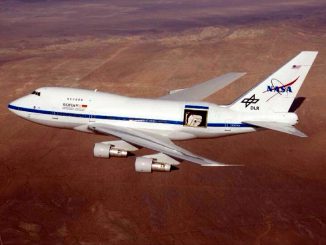
NASA’s Stratospheric Observatory for Infrared Astronomy (SOFIA) is a Boeing 747SP jetliner modified to carry a 100-inch diameter telescope to study the universe at infrared wavelengths that cannot be detected from ground-based observatories. SOFIA’s Science Cycle 5, which runs from February 2017 through January 2018, spans the entire field of astronomy from planetary science to extragalactic investigations.

Observing

The Moon meets Aldebaran and the Hyades in the evening sky of 15 November

As dusk fades to dark on the evening of Tuesday 15 November, observers in the British Isles and Western Europe can see the rising 16-day-old Moon less than 2 degrees away from Aldebaran in the constellation of Taurus. While an occultation of the star occurs around 17h UT for observers in Japan, central Asia and the Middle East, skywatchers in the UK will have to settle for a near miss.

News

Fast radio bursts born in cosmic cataclysms

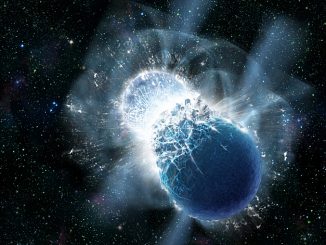
Fast radio bursts (FRBs) were first discovered in 2007, and in the years since radio astronomers have detected a few dozen of these events. Researchers have found that these mysterious “cosmic whistles” can release a billion times more energy in gamma-rays than they do in radio waves, rivalling supernovae in their explosive power.