
News


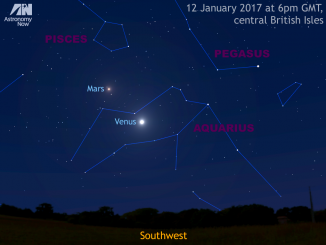
Thursday 12 January brings not only a full Moon, but also finds brightest planet Venus at its greatest easterly elongation from the Sun. By the time darkness falls in Western Europe and the UK, Venus also lies just 0.4 degrees from outermost planet Neptune, while Mars lies less than the span of a fist at arm’s length to their upper left.
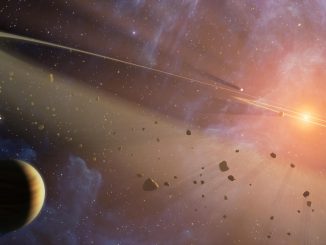
Searching for planets around other stars is a tricky business. They’re so small and faint that it’s hard to spot them. But a possible planet in a nearby stellar system may be betraying its presence in a unique way: by a shadow that is sweeping across the face of a vast pancake-shaped gas-and-dust disk surrounding a young star.
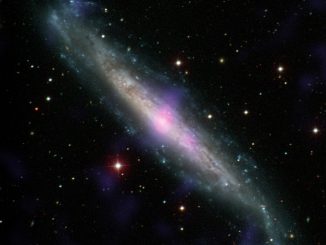
Monster black holes sometimes lurk behind gas and dust, hiding from the gaze of most telescopes. But they give themselves away when material they feed on emits high-energy X-rays that NASA’s NuSTAR mission can detect. That’s how NuSTAR recently identified two gas-enshrouded supermassive black holes, located at the centers of nearby galaxies.

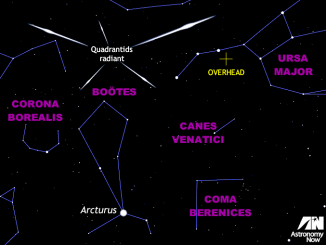
It’s time to direct your attention skyward for some celestial pyrotechnics from the first major annual meteor shower — the Quadrantids. The short-lived peak of this active shower is predicted to occur at 2pm GMT on 3 January, favouring observers in the west of North America, but most Northern Hemisphere observers with clear skies will still see some shooting stars.
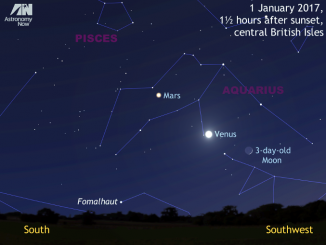
The young crescent Moon’s nightly motion from 31 December 2016 to 3 January 2017 carries it past dazzling planet Venus and first-magnitude Mars. A small telescope also reveals outermost planet Neptune, which passes just 0.02 degrees from Mars around 7h UT on 1 January, offering observers around the world a New Year’s Day treat.
© 2019 Pole Star Publications Limited