News

“We’re made of star stuff,” astronomer Carl Sagan famously said. Nuclear reactions that happened in ancient stars generated much of the material that makes up our bodies, our planet and our solar system. When stars explode in violent deaths called supernovae, those newly formed elements escape and spread out in the universe.

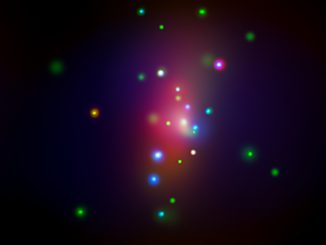
Every few thousand years, an unlucky star wanders too close to the black hole at the center of the Milky Way. The black hole’s powerful gravity rips the star apart, sending a long streamer of gas whipping outward. That would seem to be the end of the story, but it’s not. New research shows that not only can the gas gather itself into planet-size objects, but those objects then are flung throughout the galaxy in a game of cosmic “spitball.”
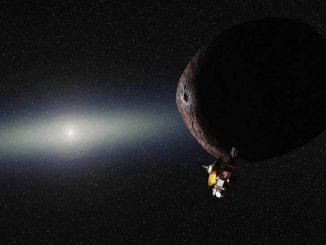
Scientists planning the the next phase of NASA’s New Horizons mission, a robotic craft that completed the first exploration of Pluto in 2015, are going into the flyby of a frozen, faraway city-sized clump of rock on New Year’s Day 2019 armed with little knowledge of the target lurking around 4 billion miles from Earth.
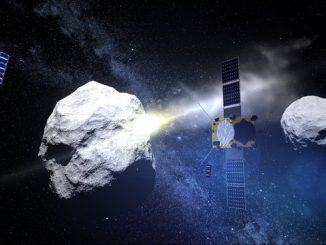
Decisions on the future of a joint robotic mission between NASA and the European Space Agency to demonstrate the ability to deflect an asteroid on a collision course with Earth have been put off until later this year after European governments declined to fully fund their part of the project in December.


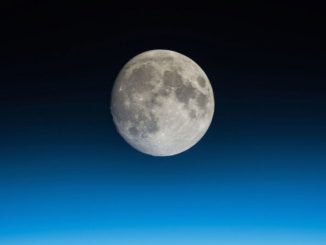
Before sunrise on Thursday 19 January, observers in Western Europe can see an interesting celestial conjunction in the southern sky. At about 6am local time, the waning gibbous Moon, largest planet Jupiter and Spica — the brightest star in the constellation of Virgo — all lie in a line encompassed by the field of view of a typical 7x or 8x binocular.
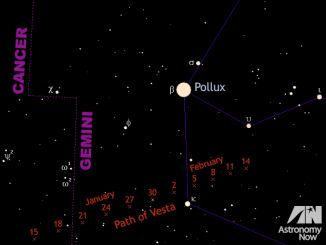
On Wednesday 18 January, brightest asteroid 4 Vesta comes to opposition in the constellation of Cancer bordering on Gemini, ideally placed for observation by Northern Hemisphere skywatchers. While the truly eagle-eyed among you might glimpse it with the unaided eye on dark, moonless nights, Vesta is an easy binocular object.
© 2019 Pole Star Publications Limited