13 March 2026
Astronomy Now
  • Home
  • The Magazine
    • About
    • Current Issue
    • Subscribe
    • Renew Subscription
  • AstroFest 2026
  • News
  • Observing
    • UK Sky Chart
    • Almanac
    • Scope Calc
    • DSLR Calc
  • Reviews
    • Equipment
    • Book Reviews
  • Spaceflight Now
  • Shop
  • Contact Us
    • Subscriptions
    • Your Views
    • Ask Astronomy Now
    • Editorial
    • Advertising
    • AstroListings
Latest News
  • [ 26 January 2026 ] Dr Allan Chapman (1946-2026) News
  • [ 16 January 2026 ] Potentially bright ‘sungrazing’ comet discovered News
  • [ 17 December 2025 ] Thank you from the editor News
  • [ 25 October 2025 ] Hubble revisits a cosmic yardstick News
  • [ 21 October 2025 ] Europe’s planet hunting spacecraft complete and ready for final testing News
  • Facebook
  • Twitter
  • LinkedIn

Archive

Picture This

Crescent-shaped nebula in Carina harbours energetic Wolf-Rayet star

3 August 2018 Astronomy Now

The European Southern Observatory’s VLT Survey Telescope captures a stunning view of a crescent-shaped nebula 12,000 light years away in the southern constellation Carina where the outflow from a hot Wolf-Rayet star helps shape the lopsided structure.

News

Astronomers stunned again by Eta Carinae – the star that will not die

3 August 2018 Astronomy Now

Eta Carinae, one of the brightest, most massive stars in the Milky Way, famously erupted 170 years ago, producing huge clouds of expanding debris. Astronomers studying light echoes from the blast may have found an explanation.

Observing

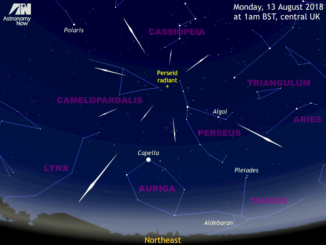
Don’t miss 2018’s favourable Perseid meteor shower, 12–13 August

3 August 2018 Ade Ashford

From the UK evening of Sunday, 12 August into the early hours of the following morning it’s the maximum of the annual Perseid meteor shower. This year, a new Moon setting in twilight makes prospects for watching this natural firework display particularly good. So, find somewhere away from the streetlights, settle into a garden lounger facing northeast and enjoy the show!

News

Successful occultation observations for New Horizons (updated 4 August)

2 August 2018 Astronomy Now

Mission planners preparing for the New Horizons flyby of a Kuiper Belt object on 1 January will attempt to monitor starlight as it is blocked out by the probe’s target, Ultima Thule, to update critical navigation data. Updated 4 August

Picture This

Cassini image captures five of Saturn’s moons in one frame

1 August 2018 Astronomy Now

In 2011, NASA’s Cassini spacecraft captured a view showing five of Saturn’s moons – Janus, tiny Pandora, the water world Enceladus, Mimas and Rhea, the planet’s second largest moon – in a single frame, a family portrait that is riveting in its stark beauty.

News

Astronomers detect radioactive molecules in debris from stellar collision

1 August 2018 Astronomy Now

Astronomers studying the remnants of a collision between two stars have made the first direct detection of radioactive material outside Earth’s solar system, debris that was blasted into space from one star’s deep interior

Observing

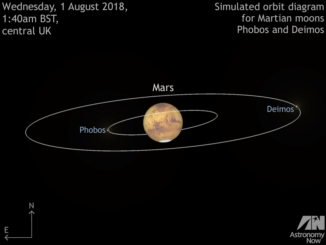
Find Martian moons Phobos and Deimos at the Red Planet’s closest approach

30 July 2018 Ade Ashford

Do you like extreme observing challenges? If you own a quality telescope of 25-cm (10-inch) aperture or larger and have excellent sky conditions, then you might just glimpse Phobos and Deimos, the diminutive moons of Mars around the time that the Red Planet is closest to Earth on 31 July.

News

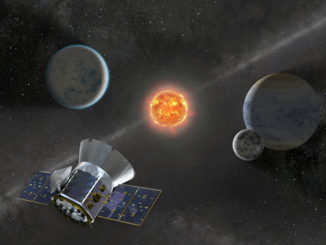
NASA’s new planet hunter starts work

30 July 2018 Stephen Clark

NASA’s newest observatory in space has started its search for planets around other stars as astronomers zero in on worlds that are ripe for research by follow-up missions like the James Webb Space Telescope.

News

‘Radio rebound’ observed in aftermath of gamma ray burst

27 July 2018 Astronomy Now

A powerful gamma ray burst two billion light years away produced a long-lasting “radio rebound” shock wave that surprised astronomers, providing new insights into such cataclysmic explosions.

Picture This

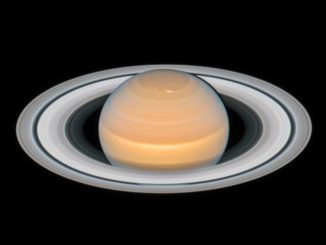
Hubble captures new views of Mars and Saturn near opposition

26 July 2018 Astronomy Now

The Hubble Space Telescope captured stunning new views of Mars and Saturn as the planets neared opposition, lined up with Earth and the Sun. Mars remains obscured by a global dust storm.

Posts pagination

« 1 … 128 129 130 … 355 »

Astronomy Now Newsletter

Join our mailing list.
* indicates required
Which elements of Astronomy interest you?

News Headlines

  • Dr Allan Chapman (1946-2026)
    26 January 2026
  • Potentially bright ‘sungrazing’ comet discovered
    16 January 2026
  • Thank you from the editor
    17 December 2025
  • Hubble revisits a cosmic yardstick
    25 October 2025
  • Europe’s planet hunting spacecraft complete and ready for final testing
    21 October 2025

© 2019 Pole Star Publications Limited

Astronomy Now