
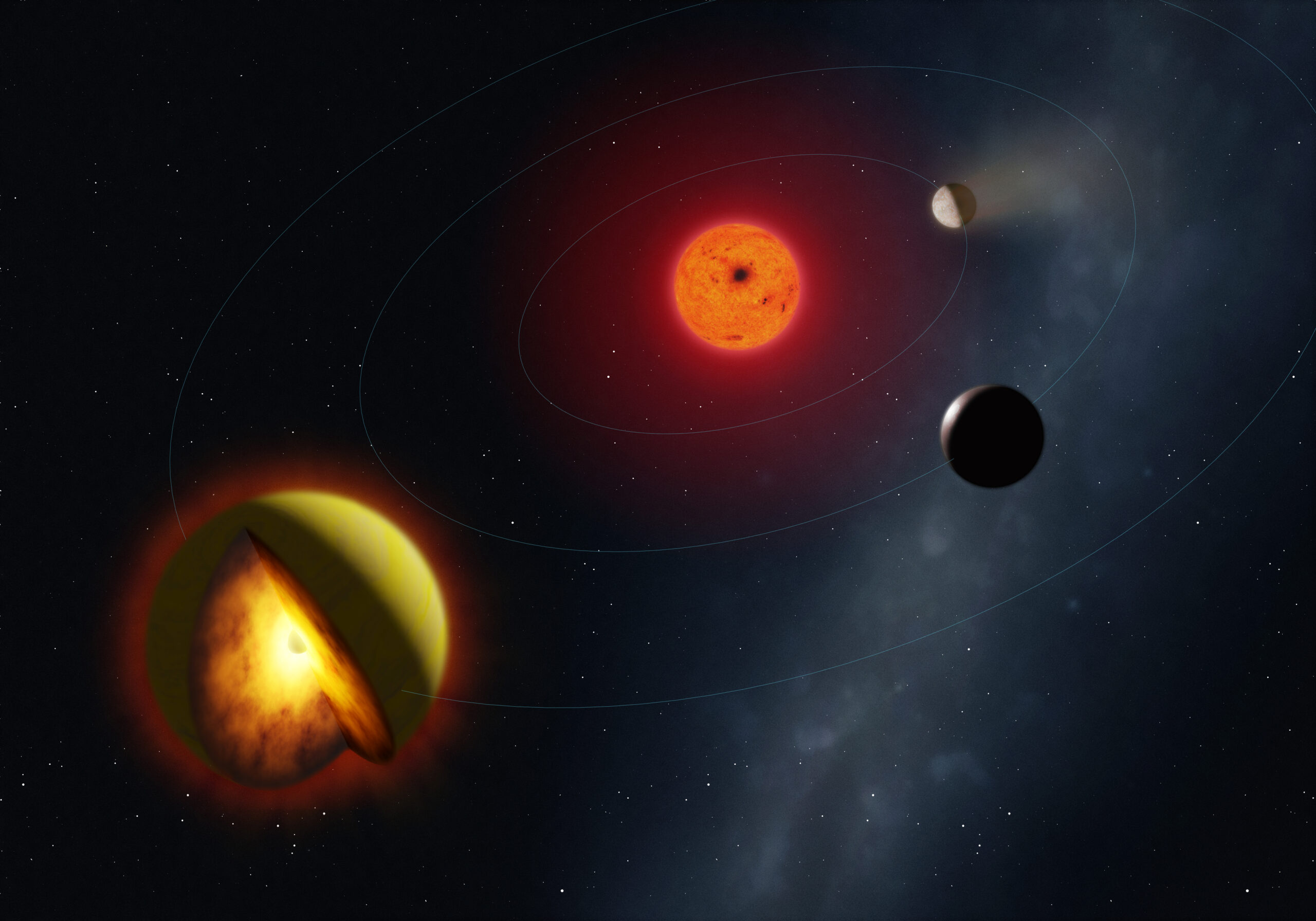
Astronomers may have discovered a completely new kind of planet, one where a vast ocean of molten rock lies beneath a sulphur-rich atmosphere. The object, known as L 98-59 d, does not fit into any of the categories astronomers normally use to classify small exoplanets.
Located about 35 light-years from Earth and roughly 1.6 times the size of our planet, L 98-59 d was expected to resemble either a hydrogen-rich “gas dwarf” or a water-laden ocean world. Instead, observations from ground-based observatories and the James Webb Space Telescope, combined with new computer models suggest something far stranger: a planet whose deep interior remains semi-molten, storing large quantities of sulphur that help shape the chemistry of its atmosphere.
If confirmed, the world could represent the first recognised member of an entirely new planetary family, and hint that many more exotic planets may be waiting to be discovered as observations improve in the coming years.
The planet orbits a small red dwarf star and forms part of a compact planetary system containing several worlds with very different properties. What makes L 98-59 d stand out is that, although roughly 1.6 times the radius of Earth, it has an unusually low density and an atmosphere that Webb showed contains sulphur-bearing gases.
These properties have proven impossible to reconcile with the categories astronomers normally use to classify small exoplanets.
“The way we’ve been doing it in the last few years is suggesting that planets are either very hydrogen-rich gas dwarfs or water-rich worlds,” Harrison Nicholls of the University of Oxford, lead author of the study published in Nature Astronomy told Astronomy Now. “But this planet specifically doesn’t fit into these categories.”
Instead, computer simulations linking the observed atmosphere to the planet’s interior suggest that L 98-59 d possesses a vast global magma ocean extending deep into its mantle. This molten reservoir acts as a chemical storehouse for volatile elements, particularly sulphur, which can be exchanged between the interior and the atmosphere over billions of years.
In this picture, sulphur-bearing gases such as hydrogen sulphide detected high in the atmosphere are ultimately connected to processes occurring deep within the planet’s molten interior.
The planet’s density was also key to this interpretation. Nicholls explains that the world is much lighter than a rocky planet like Earth. “Overall the planet’s bulk density is low, about two grams per cubic centimetre,” he says. For comparison, water’s density is 1 g/cm3, whereas the Earth’s average density is 5.5 g/cm3.”
Part of L 98-59 d’s low density reflects the presence of a substantial atmosphere, but the planet’s interior also plays a role. According to the team’s modelling, the mantle is neither fully liquid nor fully solid.
“The mantle has a viscosity not like water and not like rock, it’s more like molasses,” says Nicholls.
Such a semi-molten interior may allow the planet’s atmosphere and mantle to interact in ways not seen on Earth. Volatile elements can dissolve into the magma ocean and later be released again. Thus it shapes the atmosphere’s composition over time.
One puzzle raised by the study is why the planet has remained molten for so long. The system is thought to be roughly five billion years old, which is comparable to the age of the Sun. On the face of it, this should have given the planet ample time to cool and solidify.
The researchers argue that several factors may have kept the magma ocean alive. One is the planet’s thick atmosphere, which traps heat in a powerful greenhouse effect.
“That makes it very hard for radiation to leave the planet and for it to cool down,” says Nicholls.
Additional heating may come from tidal interactions with neighbouring planets in the system. In this process, gravitational pulls slightly distort the planet’s orbit, creating internal friction that generates heat. It is a process identical to the tidal heating that keeps Jupiter’s moon Io volcanically active in our own Solar System.
Meanwhile, the siblings of L 98-59 d are all very different from one another and Nicholls points out that studying such systems can be particularly valuable, because the planets formed around the same star but evolved in different ways.
Such diversity may also hint that previous definitions have been too restricted and that rather than falling neatly into a few broad categories, planets may fall somewhere on a spectrum of different evolutionary outcomes.
“What we’re highlighting is that there’s maybe a continuum of different exoplanet families,” says Nicholls.
If so, the discovery could mean that some planets currently classified as super-Earths or sub-Neptunes may turn out to be fundamentally different kinds of worlds, once their interiors are better understood.
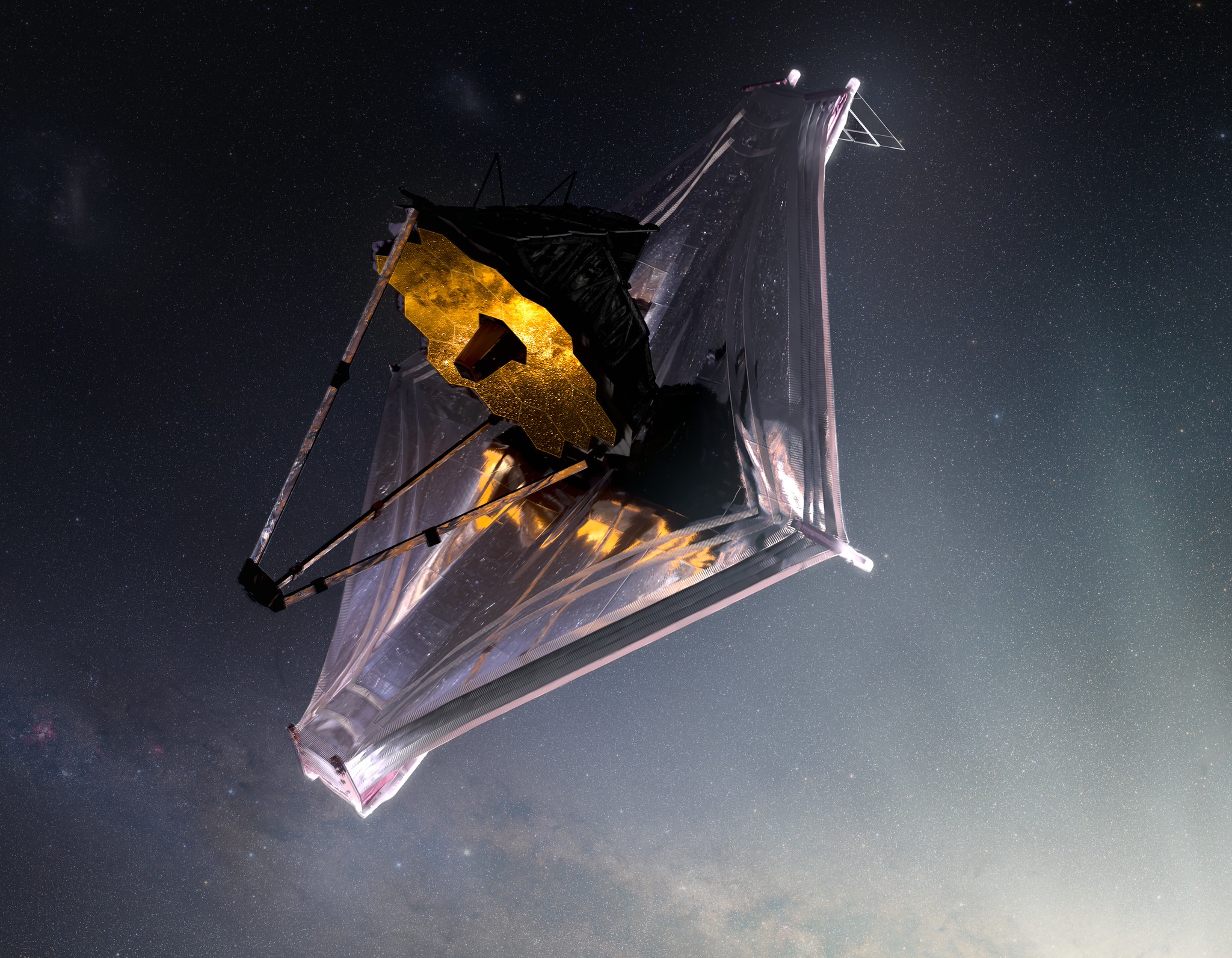
Future observations should help clarify how common such planets are. Webb is already providing detailed measurements of exoplanet atmospheres, and upcoming missions such as ESA’s Ariel and PLATO are expected to expand the census of planetary systems dramatically.
“It’s really a wild west at the moment,” says Nicholls. “We’re getting more and more data all the time, and I think we’re going to discover more planets that defy the categories we’re trying to place them in.”
L 98-59 d may therefore represent only the first glimpse of a much richer planetary menagerie. As astronomers continue to explore the Galaxy’s worlds, do not be surprised if entirely new planetary families emerge.
Read More: