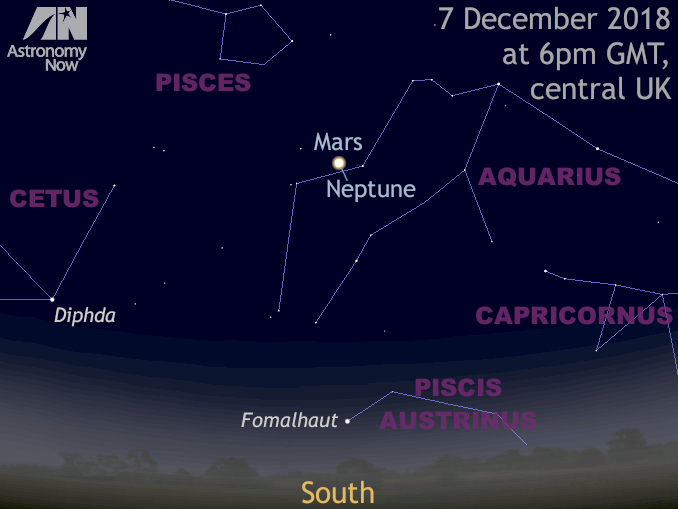
Observers in the British Isles looking due south close to 6pm GMT on Friday, 7 December will find magnitude +0.1 planet Mars about 30 degrees, or a span and a half of an outstretched hand at arm’s length, above the horizon. What you won’t see unless you have large binoculars or a small telescope is outermost planet Neptune one-tenth of a degree to the Red Planet’s lower right. Look out for Fomalhaut, the most southerly first-magnitude star visible from the UK, twinkling near the southern horizon. AN graphic by Ade Ashford.Since the beginning of the year, Mars has had conjunctions with Jupiter (7 January), Saturn (2 April) and Pluto (26 April), but its closest approach to a planetary sibling this year occurs on Friday, 7 December 2018 at 14:07 UT (2:07pm GMT) when the Red Planet passes just 2 arcminutes – one-thirtieth of a degree – north of Neptune in the constellation of Aquarius.
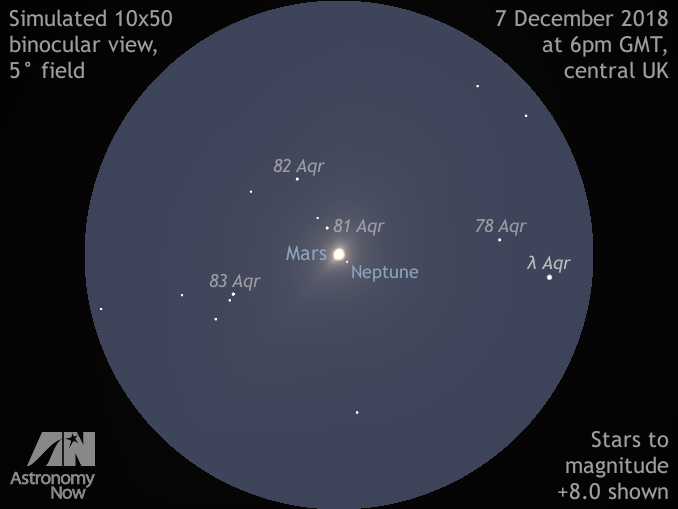
The instant of least separation between Mars and Neptune occurs in daylight for the British Isles, but observers here only have to wait a further four hours to see them in a dark sky. As astronomical twilight fades to dark around 6pm GMT in the heart of the UK, Mars and Neptune are also at their highest in the sky due south, about 30 degrees above the horizon.In this simulated 10×50 binocular view of Mars and Neptune at 6pm GMT on Friday, 7 December 2018, background field stars in Aquarius to magnitude +8 are shown. Labelled stars λ Aquarii, 78 Aquarii, 81 Aquarii, 82 Aquarii and 83 Aquarii are magnitudes +3.7, +6.2, +6.2, +6.2 and +5.4, respectively. AN graphic by Ade Ashford.By 6pm GMT on 7 December the separation of Mars and Neptune has increased to 6½ arcminutes, or about one-tenth of a degree. This means that you could theoretically use telescope magnifications up to about 400× and still see both planets in the same field of view! (In practice, seeing conditions at an altitude of 30 degrees rarely permits such powers; 150× would be more realistic.)
If you get the chance to see both Mars and Neptune in the same field of view on 7 December, do bear in mind that this conjunction is merely a line-of-sight effect. The magnitude +0.1 Red Planet lies almost 159 million kilometres away, hence its 86% illuminated gibbous disc measures just 8.8 arcseconds across. Neptune has a physical diameter 7¼ times that of Mars but lies slightly more than 28 times farther away this night, hence its pale blue magnitude +7.9 disc spans just 2.3 arcseconds.
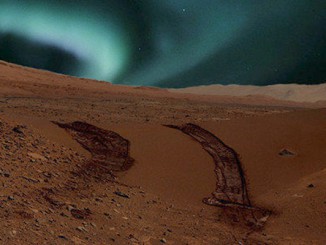
For the first time, an international team of scientists from NASA, the Institute of Planetology and Astrophysics of Grenoble (IPAG), the European Space Agency and Aalto University in Finland, have predicted that colourful, glowing aurorae can be seen by the naked eye on a terrestrial planet other than Earth — Mars.
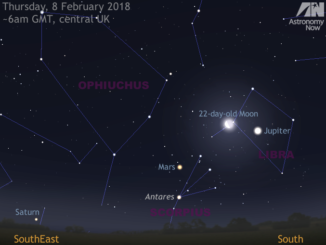
Set your alarm for 6am GMT if you wish to see three naked-eye planets in the UK dawn sky this week. Find a location that offers an unobstructed view of the horizon from southeast to south and let the waning Moon be your guide to locating Jupiter, Mars and Saturn on successive mornings from 7 to 11 February.
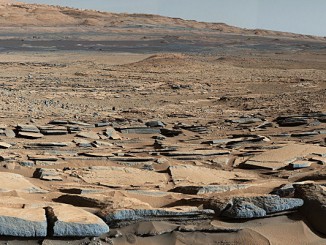
A new study has confirmed that Mars was once, billions of years ago, capable of storing water in lakes over an extended period of time. Using data from NASA’s Curiosity rover, the team behind Mars Science Laboratory has determined that, long ago, water helped deposit sediment into Gale Crater, where the rover landed on 6 August 2012.