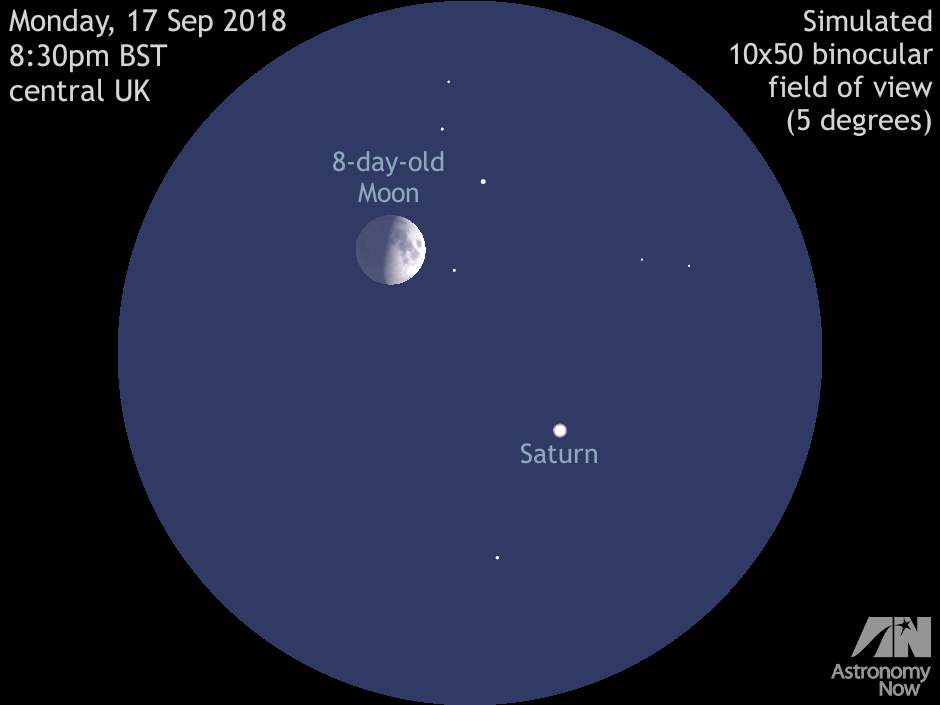
Skywatchers in Western Europe (including the UK) should look low in the south-southwest around the start of nautical dusk (~8:30pm BST in the heart of the British Isles) on Monday, 17 September to see this close conjunction between Saturn and a Moon just past first quarter phase in the constellation of Sagittarius. AN graphic by Ade Ashford.Observers in the UK with a clear sky in the south-southwest around 8:30pm BST on Monday, 17 September can see the 8-day-old Moon just 1¾ degrees to the upper left of magnitude +0.4 Saturn in deep twilight. Both the ringed planet and the Moon will fit comfortably in the field of view of binoculars and small telescopes at magnifications less than about 25×, but you’ll need a telescope magnifying at least twice that if you wish to see the planet’s ring system clearly.
Saturn was at opposition on 27 June, so observers in northern temperate latitudes such as the UK are now seeing the planet setting in the west-southwest four hours after the Sun. If you wish to make any observations of the ringed planet you need to be ready as soon as the sky’s dark enough to see it, a task made much easier by the Moon’s proximity on the night in question.
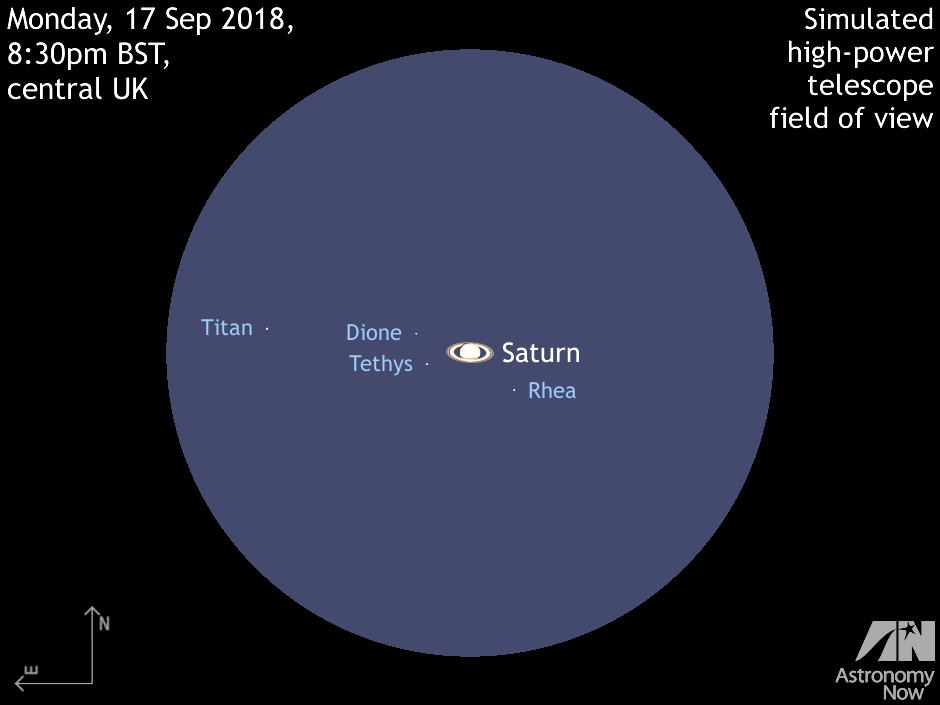
The UK evening of 17 September finds Saturn almost 9.88 astronomical units or 1,478 million kilometres from Earth, some 3690 times farther away than our waxing gibbous Moon almost in the same line of sight. This is also a good evening to spot Saturn’s largest and brightest moon, magnitude +9.3 Titan, since it lies close to greatest easterly elongation from its parent planet. See the graphic below for the configuration of the brighter Saturnian moons this night.The aspect of Saturn and its brightest moons Titan and Rhea, with lesser moons Tethys and Dione for larger backyard ‘scopes, on the UK night of 17 September 2018. Observers with Newtonian/Dobsonian telescopes should rotate this image through 180 degrees to match their eyepiece view, while users of refractors and catadioptrics (Schmidt- and Maksutov-Cassegrains) with a star diagonal need to mirror this graphic left-right to replicate what they see through the eyepiece. AN graphic by Ade Ashford.
An international team of scientists has solved an age-old scientific riddle by discovering that planetary rings, such as those orbiting Saturn, have a universally similar particle distribution. The study also suggests that Saturn’s rings are essentially in a steady state that does not depend on their history.
Outermost planet Neptune is currently visible in binoculars if you know just where to look. Fortunately, Mars forms a convenient guide on the night of 19th January as the two planets appear close together in the early evening sky.
On the morning of Saturday, 9 January — just two days after their photogenic conjunction with an old crescent Moon — planets Venus and Saturn reach the denouement of their pre-dawn show with a spectacular close conjunction. To observe this spectacle you need an unobstructed view low to the southeast around 7am GMT (central British Isles).