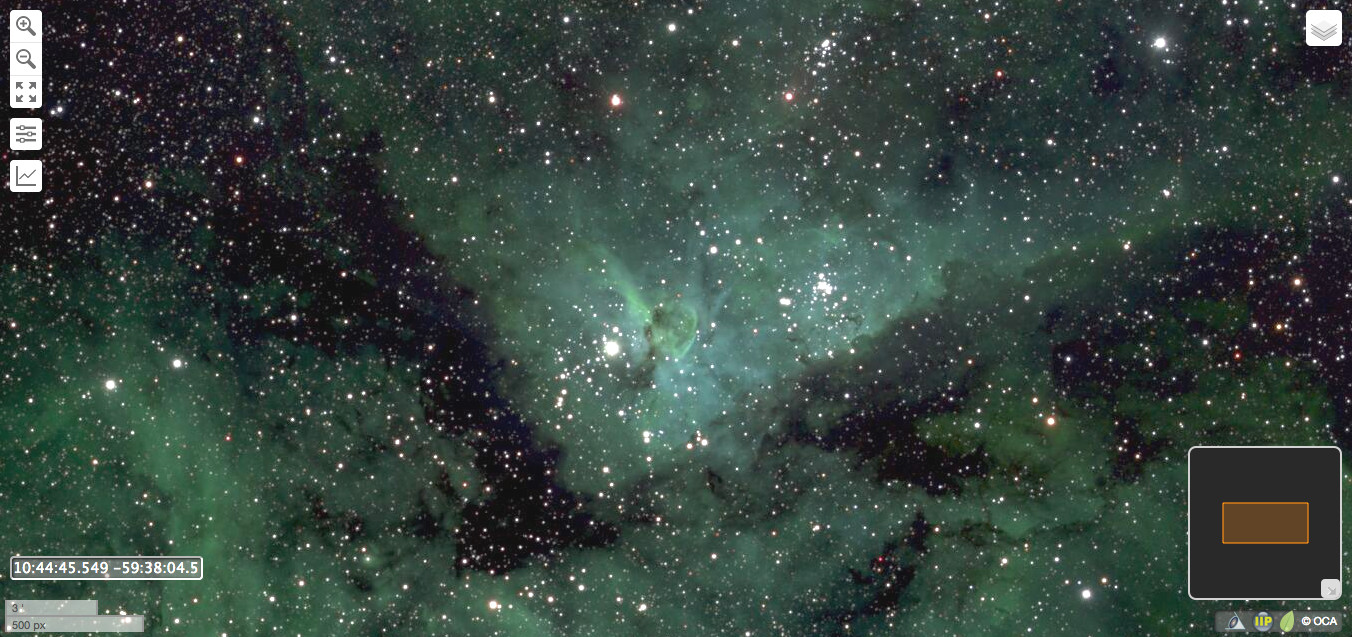
This is a zoomed-in section of the 46 billion-pixel Milky Way picture depicting the Eta Carinae Nebula. An online tool provided by astronomers at the Ruhr-Universität Bochum (RUB) permits users to navigate the huge image by named object or celestial coordinates, zoom in or out, or apply specific filters. Image credit: Lehrstuhl für Astrophysik, RUB. AN screen capture by Ade Ashford.For five years, the astronomers at the Ruhr-Universität Bochum (RUB) have been monitoring our galaxy in the search of objects with variable brightness. Those objects may, for example, include stars in front of which a planet is passing, or multiple systems where stars orbit each other and which obscure each other every now and then. In his PhD thesis, Moritz Hackstein is compiling a catalogue of such variable objects of medium brightness. For this purpose, the team from the Faculty of Physics and Astronomy takes pictures of the southern sky night after night. To this end, they use the telescopes at Bochum’s university observatory in the Atacama Desert in Chile. More than 50,000 new variable objects, which had hitherto not been recorded in databanks, have been discovered by the researchers so far.
268 Individual Images Make Up the Photo of the Milky Way
The area that the astronomers observe is so large that they have to subdivide it into 268 sections. They photograph each section in intervals of several days. By comparing the images, they are able to identify the variable objects. The team has assembled the individual images of the 268 sections into one comprehensive image. Following a calculation period of several weeks, they created a 194 Gigabyte file, into which images taken with different filters have been entered.
Online Tool Facilitates Search for Individual Celestial Objects
Using the online tool, any interested person can view the complete ribbon of the Milky Way at a glance, or zoom in and inspect specific areas. An input window, which provides the position of the displayed image section, can be used to search for specific objects. If the user types in “Eta Carinae,” for example, the tool moves to the respective star; the search term “M8” leads to the Lagoon Nebula.
Many galaxies blast huge, wide-angled flows of material outward from their centres, pushing to their outer edges enough dust and gas each year that otherwise would have formed more than a thousand stars the size of our Sun. A team led by University of Maryland scientists has found the driving force behind these massive molecular outflows.
Astronomers at Swinburne University of Technology, Melbourne, have discovered an unusually shaped structure in two nearby disc galaxies. The Swinburne team recently developed new imaging software, making it possible to observe the double “peanut shell shape” formed by the distribution of stars bulging from the centres of these galaxies.
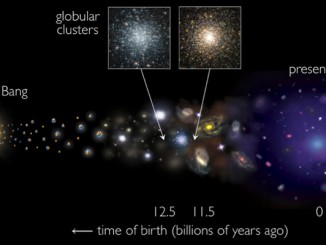
Using a new age-dating method and the W. M. Keck Observatory, an international team of astronomers have determined that globular star clusters formed in two distinct epochs — 12.5 and 11.5 billion years ago. They formed alongside galaxies, rather than prior to galaxies, as previously thought.