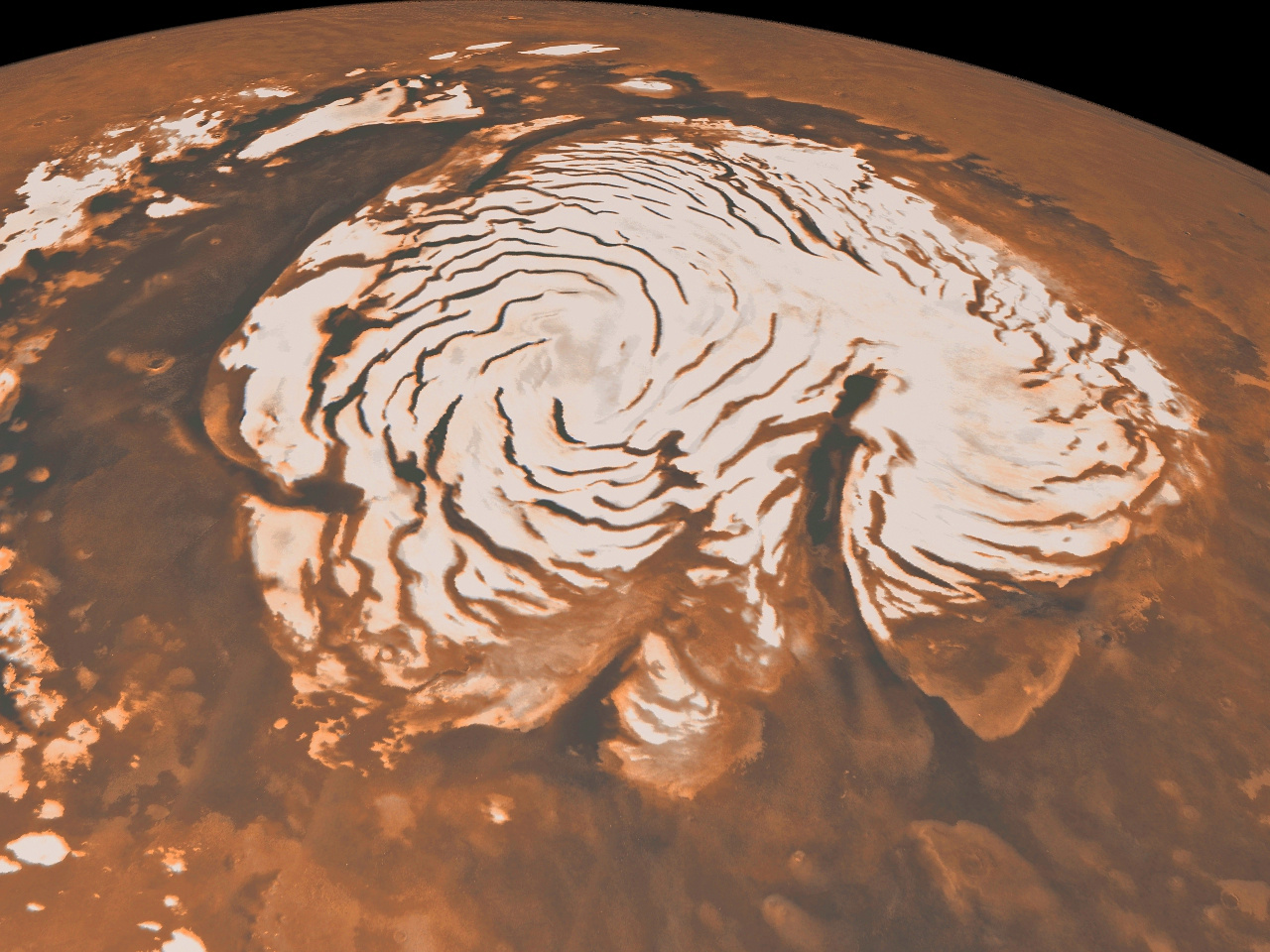
Combining Mars Reconnaissance Orbiter radar data with images of Mars’ north pole, a Southwest Research Institute team found evidence for an ice age on the Red Planet. This image is from NASA’s Mars Global Surveyor. Image credit: NASA/JPL-Caltech/MSSS.Using radar data collected by NASA’s Mars Reconnaissance Orbiter, a Southwest Research Institute-led team found evidence of an ice age recorded in the polar deposits of Mars. Ice ages on Mars are driven by processes similar to those responsible for ice ages on Earth, that is, long-term cyclical changes in the planet’s orbit and tilt, which affect the amount of solar radiation it receives at each latitude.
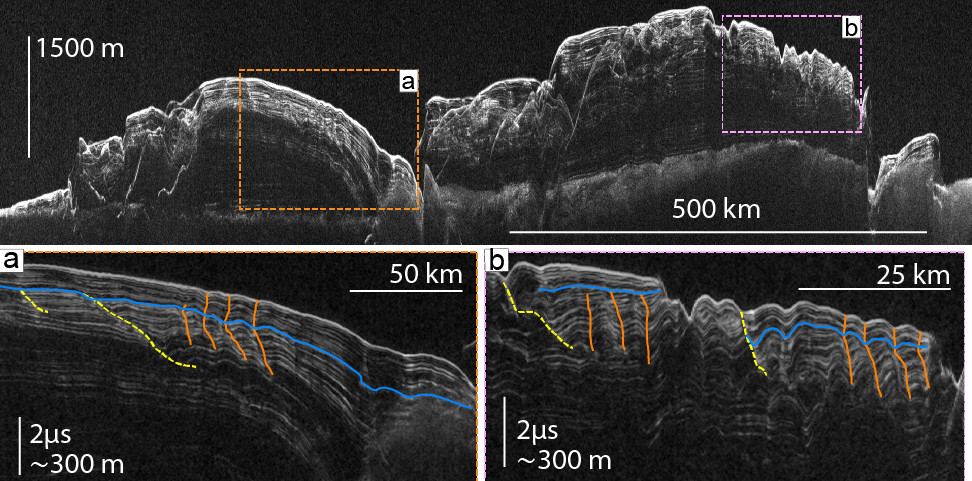
“We found an accelerated accumulation rate of ice in the uppermost 100 to 300 metres of the polar cap,” said Dr. Isaac Smith, a postdoctoral researcher at SwRI and lead author of a paper published in the 27 May issue of Science. “The volume and thickness of ice matches model predictions from the early 2000s. Radar observations of the ice cap provide a detailed history of ice accumulation and erosion associated with climate change.”Using two-dimensional radar cross sectional images collected by the Shallow Radar instrument on Mars Reconnaissance Orbiter, SwRI scientists discovered evidence for an ice age in the Mars’ polar cap. The top 100- to 300-metre layers of ice show a stark change in properties between an ice age and an inter-glacial period. In the highlighted boxes, layers below the blue line show migration of spiral features toward the left (yellow and orange lines). Above the blue line, those features disappear or reverse migration direction, an indication of changes in accumulation rate and wind patterns associated with climate change. In other regions of the polar cap, the blue line is associated with widespread erosion, an event that corresponded with an ice age. Image credit: SwRI.Like Earth, modern-day Mars experiences annual rotation and seasonal cycles, as well as longer cycles, that influence the distribution of ice. However, these longer cycles might be more pronounced on Mars. This is because Mars’ tilt changes substantially — by as much as 60 degrees — on timescales of hundreds of thousands to millions of years. By comparison, the Earth’s tilt varies by only about 2 degrees over the same period. On Mars, this greater variability determines the amount of sunlight reaching a given spot on the surface and thus the stability of ice at all latitudes.
“Because the climate on Mars fluctuates with larger swings in axial tilt, and ice will distribute differently for each swing, Mars would look substantially different in the past than it does now,” said Smith. “Furthermore, because Mars has no oceans at present, it represents a simplified ‘laboratory’ for understanding climate science on Earth.”SwRI scientists used this 3-D perspective view of Mars’ polar ice cap to look for signs of climate change. Similar to profile views in two dimensions, the white line highlights the exact level in the ice where a change in climate occurred. On Mars, ice transfers from the north pole to the mid-latitudes during an ice age, leaving behind evidence of erosion. Subsequent accumulation (above the white line) indicates that the ice age was over. Image credit: Fritz Foss and Nathaniel Putzig.Detailed measurements of ice thickness show that about 87,000 cubic kilometres of ice have accumulated at the poles since the end of the last ice age about 370,000 years ago; the majority of the material accumulated at the Martian north pole. This volume is equivalent to a layer of 60 centimetres if spread uniformly across the surface. These results provide a means to understand the accumulation history of the polar deposits as related to Mars movements, such as orbital eccentricity, axial tilt, and rotation around the Sun. The results will support modelling efforts to understand the Martian climate, looking at the movement of ice from poles to mid-latitudes during climate cycles.
“Studying ice on Mars also is important to the future of human exploration of the Red Planet,” said Smith. “Water will be a critical resource for a Martian outpost.”
From possible ice volcanoes to twirling moons, NASA’s New Horizons science team is discussing more than 50 exciting discoveries about Pluto at this week’s 47th Annual Meeting of the American Astronomical Society’s Division for Planetary Sciences. The two cryovolcano candidates are large features measuring tens of miles across and several miles high.
NASA’s Perseverance rover provides a razor-sharp mosaic showing its view across the floor of Jezero Crater, including remnants of a delta where water once flowed into a broad lake that may have provided a habitable environment for microbial life.
In the small hours of Friday, 16 October, innermost planet Mercury reaches its greatest westerly elongation from the Sun. For those of you in the UK with a flat, unobscured eastern horizon and willing to get up an hour before sunrise, the next few days provide your best opportunity to see Mercury from the Northern Hemisphere during 2015.