
News

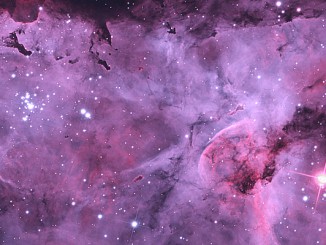
Our tenth nomination from the prestigious Insight Astronomy Photographer of the Year competition, an annual celebration of the most beautiful and spectacular visions of the cosmos by astrophotographers worldwide. The 2015 competition received 2700 spectacular entries from over 60 countries and the winners will be announced 17 September.
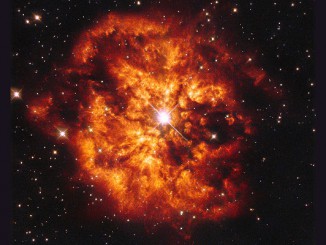
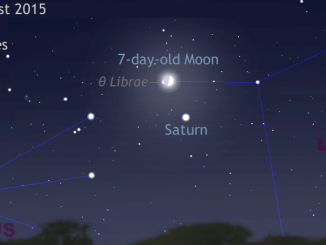
As dusk fades to dark on Saturday, 22 August, observers in the British Isles and Western Europe with clear skies can see the first quarter Moon close above planet Saturn low to the southwest. But for those skywatchers with binoculars and small telescopes, an additional treat is in store as the Moon passes in front of (occults) a naked-eye star.
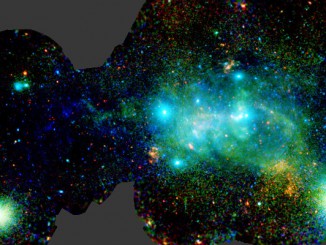
A newly released image from the ESA’s XMM-Newton X-ray satellite observatory gives us a unprecedented look at the intense processes taking place at the centre of our Milky Way galaxy. The new study, which spans a thousand light-years, is a compilation of one and a half months of monitoring, revealing the powerful remnants of dead stars and their mighty action on the surrounding gas.
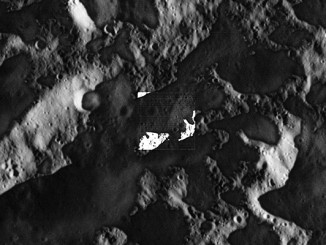
A pockmarked, icy landscape looms beneath NASA’s Cassini spacecraft in new images of Saturn’s moon Dione taken during the mission’s last close approach to the small, frozen world. Two of the new images show the surface of Dione at the best resolution ever. Cassini passed 295 miles (474 kilometres) above Dione’s surface at 7:33pm BST on 17 August 2015.
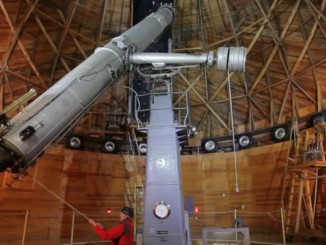
Lowell Observatory in Flagstaff, Arizona is famous as the place where dwarf planet Pluto was discovered by Clyde Tombaugh in 1930, but it has an illustrious 121-year-old record of astronomical research and discovery. After a 20-month-long restoration project, Lowell’s historic 24-inch Alvan Clark refractor is poised to reopen for public observing sessions.
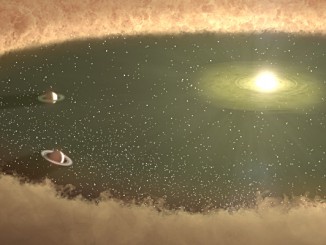
Researchers at Southwest Research Institute (SwRI) and Queen’s University in Canada have unravelled the mystery of how Jupiter and Saturn likely formed using computer simulations. The discovery, which changes our view of how all planets might have formed, also suggests that the gas giants in the solar system probably formed before the terrestrial planets.
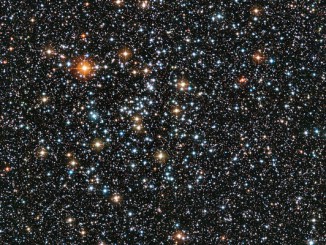
Most stars form within clusters and these clusters can be used by astronomers as laboratories to study how stars evolve and die. The cluster captured here by the Wide Field Imager (WFI) at ESO’s La Silla Observatory is known as IC 4651, and the stars born within it now display a wide variety of characteristics.
© 2019 Pole Star Publications Limited