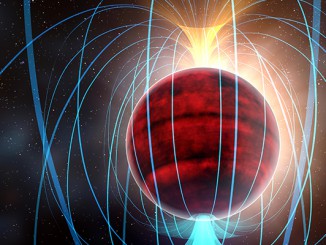
News

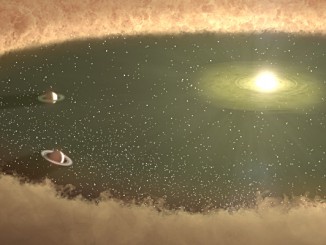
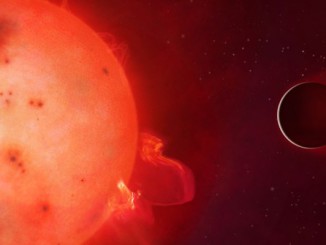
Stanford University researchers announce evidence of an exoplanet being born that could move us one step closer to understanding the process of planet formation around other stars. The alien planet, called LkCa 15 b, orbits a star 450 light-years away and appears to be on its way to growing into a world similar to Jupiter.
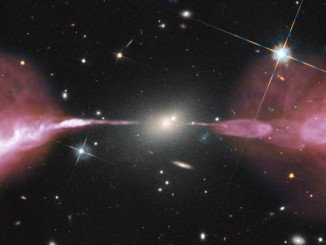
Scientists often use the combined power of multiple telescopes to reveal the secrets of the universe — and this image of elliptical galaxy Hercules A is a prime example of when this technique is strikingly effective. Radio observations with the Karl G. Jansky Very Large Array were combined with the Hubble visible-light data obtained with the Wide Field Camera 3 to create this striking composite image.
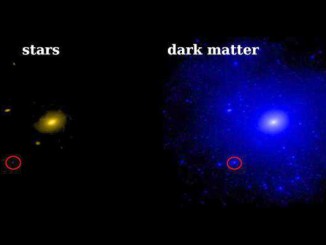
Dark matter is called “dark” for a good reason. Although they outnumber particles of regular matter by more than a factor of 10, particles of dark matter are elusive. Now, by measuring the mass of a nearby dwarf galaxy called Triangulum II, astronomers believe they may have found the highest concentration of dark matter in any known galaxy.
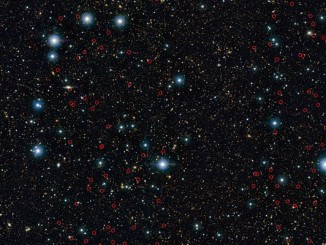
ESO’s VISTA survey telescope has spied a horde of previously hidden massive galaxies that existed when the universe was in its infancy. By discovering and studying more of these galaxies than ever before, astronomers have, for the first time, found out exactly when such monster galaxies first appeared.
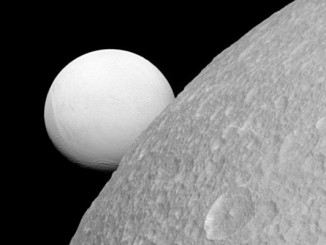
Although Saturn’s moons Dione (near) and Enceladus (far) are composed of nearly the same materials, Enceladus has a considerably higher reflectivity than Dione. As a result, it appears brighter against the dark night sky. This image was taken by NASA’s Cassini spacecraft in visible light with the narrow-angle camera on 8 September 2015.
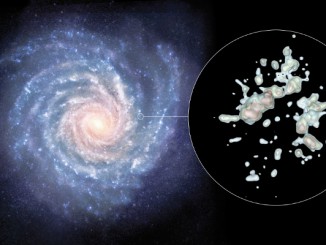
Astronomers have used modern techniques to create a 3-D visualisation of all of the O- and B-type stars within 500 parsecs (1,630 light-years) of the Sun using data from ESA’s Hipparcos satellite. This new visualisation uncovers evidence for new structures in the distribution of these nearby hot stars, and new and surprising theories of how those stars formed.
© 2019 Pole Star Publications Limited