News
Newly discovered fast-growing galaxies could solve cosmic riddle
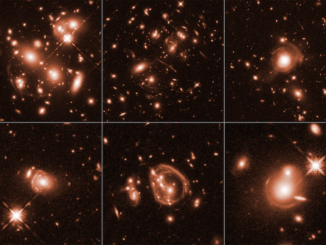
Astronomers have discovered a new kind of galaxy in the early universe, less than a billion years after the Big Bang. These galaxies are forming stars more than a hundred times faster than our own Milky Way. The discovery could explain an earlier finding: a population of surprisingly massive galaxies at a time 1.5 billion years after the Big Bang, which would require such hyper-productive precursors to grow their hundreds of billions of stars.
Jupiter surprises in first trove of data from NASA’s Juno mission
The first months of observations of the solar system’s biggest planet from NASA’s Juno spacecraft have revealed huge swirling polar cyclones, previously-undetected structures and motions beneath Jupiter’s distinctive clouds, and the first evidence for what lies at the core of the gas giant, scientists said Thursday.
Earlier launch of NASA’s Psyche mission touted as cost-saving measure
A NASA spacecraft set to explore a metallic asteroid for the first time will launch in 2022, a year earlier than originally planned, and reach its destination in 2026, four years ahead of schedule, giving ground teams a shorter wait for the mission’s scientific payoff and shaving $100 million off the project’s total cost, officials said Wednesday.
Probe into crash of ESA lander recommends more checks on ExoMars descent craft
Investigators who studied the crash of the European Space Agency’s Schiaparelli lander on Mars last year have recommended more stringent testing and computer modeling before the launch of a joint European-Russian landing craft in 2020 to avoid a repeat of the mistakes that doomed the probe’s descent through the Martian atmosphere.
VLA reveals new object near supermassive black hole in famous galaxy
Pointing the Very Large Array at a famous galaxy for the first time in two decades, a team of astronomers got a big surprise, finding that a bright new object had appeared near the galaxy’s core. The object, the scientists concluded, is either a very rare type of supernova explosion or, more likely, an outburst from a second supermassive black hole closely orbiting the galaxy’s primary, central supermassive black hole.
NASA’s Cassini spacecraft aims to skirt Saturn’s innermost ring
Fresh off its fifth passage through a gap between Saturn’s atmosphere and rings, NASA’s robotic Cassini spacecraft is looping toward a close brush with the planet’s innermost ring next week, when the probe will again use its high-gain antenna as a shield against icy particles that may lie in its path.