News

Did the ancient Egyptians record the period of eclipsing binary Algol?

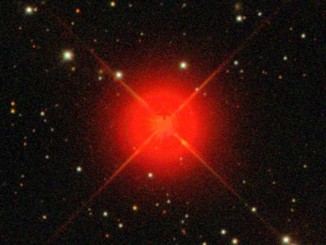
A scholarly investigation of the Cairo Calendar papyrus (1244–1163 B.C.) has led researchers at the University of Helsinki to conclude that the ancient Egyptians were aware that the variable star Algol (beta Persei) had a 2.85-day period. Given that the star’s current period is 2.8673 days, this supports the theory that mass transfer between the stars of this eclipsing binary has caused a long-term increase of its orbital period.
News

Asteroid looks even better second time around

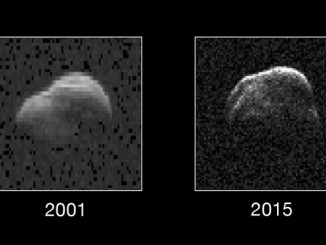
Asteroid 1998 WT24 safely flew past Earth on 11 December at a distance of about 2.6 million miles (11 lunar distances). During its flyby, NASA scientists used the 230-foot (70-metre) DSS-14 antenna at Goldstone, California, to probe it with microwave transmissions. Using this technique, they created the highest-resolution radar pictures of the asteroid — 2.5 times better than when it was last imaged, 14 years ago.

News

Final results of NameExoWorlds public vote released

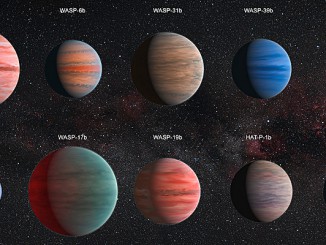
The votes are in — the names of 19 ExoWorlds (14 stars and 31 exoplanets orbiting them) have been chosen by public vote in the NameExoWorlds contest, and accepted by the IAU. Reflecting the truly international interest in astronomy, over half a million votes from 182 countries and territories contributed to the new official designations of the alien worlds.

News

Gamma rays from distant blazar galaxy tell story of an epic escape

In April 2015, after travelling for about half the age of the universe, a flood of powerful gamma rays from a distant galaxy slammed into Earth’s atmosphere. Observations of PKS 1441+25, a rare type of galaxy called a blazar, provide a look into the environment near a supermassive black hole at the galaxy’s centre and offer a glimpse into the state of the cosmos 7 billion years ago.

News

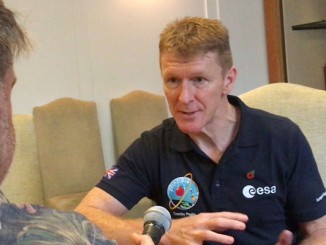
Live Coverage: The flight of British astronaut Tim Peake

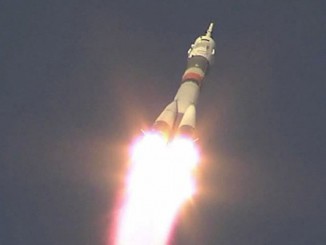
Live coverage of the launch of British ESA astronaut Tim Peake to the International Space Station. The three-man Expedition 46 crew led by five-time space flier Yuri Malenchenko will ride a Soyuz rocket into orbit, speeding away from a Kazakh launch pad on a six-hour chase of the International Space Station. Liftoff is occurred on time at 1103 GMT.