News

Cassini spacecraft samples interstellar dust near Saturn

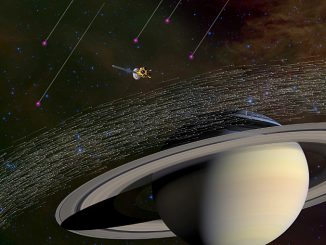
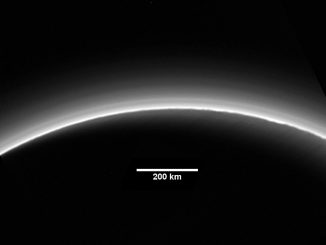
NASA’s Cassini spacecraft has been in orbit around Saturn since 2004, studying the giant planet, its rings and its moons. Among the myriad microscopic grains collected by Cassini, a special three dozen stand out from the crowd. Scientists conclude these specks of material came from interstellar space — the space between the stars.

News

Dwarf dark galaxy hidden in ALMA gravitational lens image

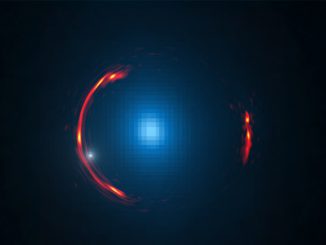
Subtle distortions hidden in a stunning Atacama Large Millimetre/submillimetre Array (ALMA) image of the gravitational lens SDP.81 are telltale signs that a dwarf dark galaxy is lurking in the halo of a much larger galaxy nearly 4 billion light-years away. This discovery could help astronomers address important questions on the nature of dark matter.

News

Mysterious alignment of black holes discovered

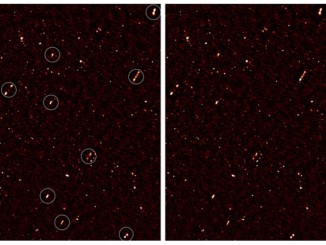
Deep radio imaging by researchers in the University of Cape Town and University of the Western Cape, in South Africa, has revealed that supermassive black holes in a region of the distant universe are all spinning out radio jets in the same direction — most likely a result of primordial mass fluctuations in the early universe.

News

Hot super-Earth atmospheres stripped by nearby host stars

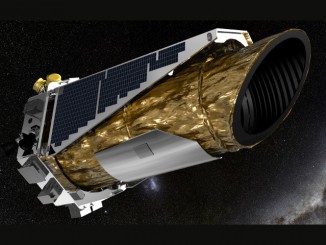
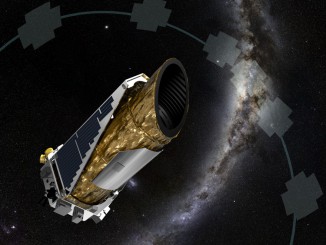
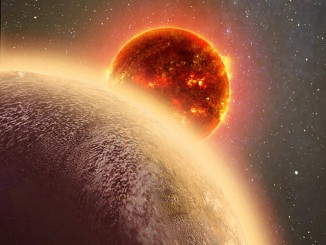
Astrophysicists at the University of Birmingham have used data from NASA’s Kepler space telescope to look at super-Earths, which are planets outside our solar system with a mass 1-10 times the mass of Earth. In particular, the researchers focused on hot super-Earths whose atmospheres have been stripped away by intense radiation from nearby host stars.

News

Climate change creates wobbles in Earth’s spin axis

Earth does not always spin on an axis running through its poles. Instead, it wobbles irregularly over time, currently drifting toward the British Isles at 17cm per year. These wobbles don’t affect our daily life, but they must be taken into account to get accurate results from GPS, satellites and observatories on the ground.