News

Brown dwarfs hiding in plain sight in our solar neighbourhood

Brown dwarfs are sometimes called failed stars as they are too small to sustain the hydrogen fusion process that powers stars. Their temperatures can range from nearly as hot as a star to as cool as a planet and their masses also range between star-like and giant-planet-like. A near-infrared survey has discovered several ultracool brown dwarfs in the Sun’s vicinity.

News

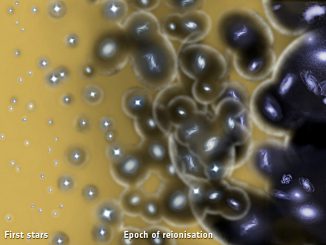
First stars formed even later than previously thought

ESA’s Planck satellite has revealed that the first stars in the universe started forming later than previous observations of the Cosmic Microwave Background indicated. This new analysis also shows that these stars were the only sources needed to account for reionising atoms in the cosmos, having completed half of this process when the universe had reached an age of 700 million years.

News

Record-breaking galaxy cluster discovered

A new record for the most distant galaxy cluster has been set using NASA’s Chandra X-ray Observatory and other telescopes. CL J1001+0220 is located about 11.1 billion light-years from Earth. The discovery of this object pushes back the formation time of galaxy clusters — the largest structures in the universe held together by gravity — by about 700 million years.