News
Pluto ‘paints’ its largest moon red
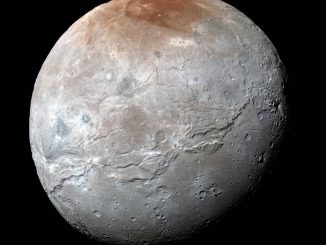
In June 2015, when the cameras on NASA’s approaching New Horizons spacecraft first spotted the large reddish polar region on Pluto’s largest moon, Charon, mission scientists knew two things: they’d never seen anything like it elsewhere in our Solar System, and they couldn’t wait to get the story behind it.
What happened after the lights came on in the universe?
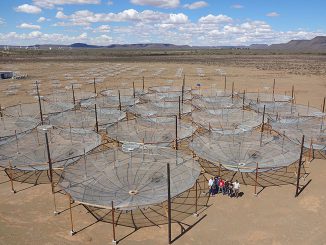
The National Science Foundation has approved funding to expand the Hydrogen Epoch of Reionisation Array (HERA) in South Africa. Upgrading the number of antennas from 19 to 240 by the year 2018 will enable HERA to study more clearly the impact of cosmic dawn, the moment a few hundred million years after the Big Bang when the first stars and galaxies blazed awake.
Discovery nearly doubles known quasars from the ancient universe
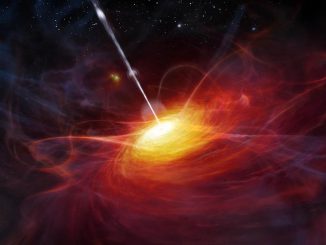
Quasars are supermassive black holes that sit at the centre of enormous galaxies, accreting matter. They shine so brightly that they are among the most distant objects in the universe that we can currently study. New work from a team led by Carnegie’s Eduardo Bañados has discovered 63 new quasars from when the universe was just 7 percent of its present age.
Young magnetar likely slowest pulsar ever detected
Using X-ray observatories, astronomers have found evidence for what is likely one of the most extreme pulsars, or rotating neutron stars, ever detected. The source exhibits properties of a highly magnetised neutron star, or magnetar, yet its deduced spin period of 6⅔ hours is thousands of times longer than any pulsar ever observed.
New research reveals hundreds of undiscovered black holes
It is only as recently as 2013 that astrophysicists found individual black holes in globular clusters via rare phenomena in which a companion star donates material to the black hole. New research by the University of Surrey on a globular cluster known as NGC 6101 shows that it could host several hundred black holes — a phenomenon that until recently was thought impossible.