News
Juno dives over Jupiter’s cloud tops with main engine still offline
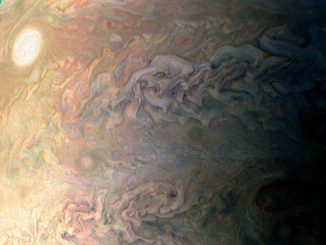
NASA’s Juno spacecraft made a high-speed pass less than 3,000 miles over Jupiter’s turbulent clouds Thursday, taking dozens of pictures, measuring radiation and plasma waves, and peering deep inside the planet’s atmosphere, but officials still have not cleared the orbiter’s main engine for a planned maneuver to position the probe for improved science observations.
NASA’s Fermi discovers the most extreme blazars yet
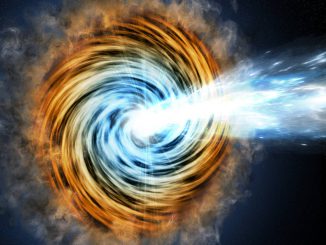
NASA’s Fermi Gamma-ray Space Telescope has identified the farthest gamma-ray blazars, a type of galaxy whose intense emissions are powered by supersized black holes. Light from the most distant object began its journey to us when the universe was 1.4 billion years old, or nearly 10 percent of its present age.
Cosmic lenses support finding on faster than expected expansion of the Universe
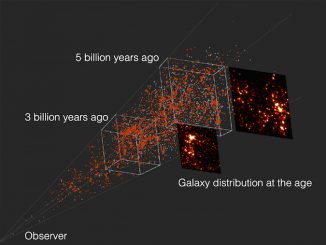
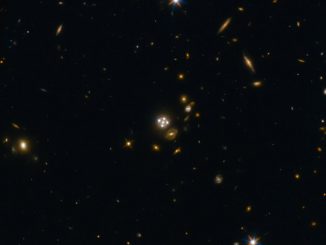
By using galaxies as giant gravitational lenses, an international group of astronomers using the Hubble Space Telescope have made an independent measurement of how fast the Universe is expanding. The newly measured expansion rate for the local Universe is consistent with earlier findings. These are, however, in intriguing disagreement with measurements of the early Universe.
NuSTAR finds new clues to ‘chameleon supernova’
“We’re made of star stuff,” astronomer Carl Sagan famously said. Nuclear reactions that happened in ancient stars generated much of the material that makes up our bodies, our planet and our solar system. When stars explode in violent deaths called supernovae, those newly formed elements escape and spread out in the universe.
Our galaxy’s black hole is spewing out planet-size ‘spitballs’
Every few thousand years, an unlucky star wanders too close to the black hole at the center of the Milky Way. The black hole’s powerful gravity rips the star apart, sending a long streamer of gas whipping outward. That would seem to be the end of the story, but it’s not. New research shows that not only can the gas gather itself into planet-size objects, but those objects then are flung throughout the galaxy in a game of cosmic “spitball.”