Picture This

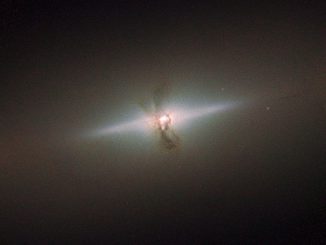
Lenticular galaxy conceals an eventful past

The elegant simplicity of NGC 4111, seen here in this image from the NASA/ESA Hubble Space Telescope, hides a more violent history than you might think. NGC 4111 is a lenticular, or lens-shaped, galaxy, lying about 50 million light-years from us in the constellation of Canes Venatici (The Hunting Dogs).

News

Pluto’s atmospheric haze varies in brightness

Scientists on NASA’s New Horizons mission team are learning more about the structure and behaviour of Pluto’s complex atmosphere by discovering new attributes of its extensive haze layers. The hazes were first discovered by New Horizons in July 2015, as the spacecraft swept past Pluto and made its historic first exploration of the mysterious dwarf planet.

News

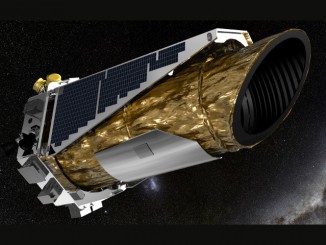
Kepler spacecraft remains stable as health check continues

NASA’s Kepler planet-hunter spacecraft remains stable as the process of returning it to science continues. The cause of the anomaly, first reported on 8 April, remains under investigation. Charlie Sobeck​, Kepler and K2 mission manager at NASA’s Ames Research Center, explains the steps taken by mission operations engineers to resume the K2 mission.

News

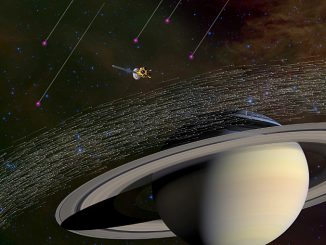
Cassini spacecraft samples interstellar dust near Saturn

NASA’s Cassini spacecraft has been in orbit around Saturn since 2004, studying the giant planet, its rings and its moons. Among the myriad microscopic grains collected by Cassini, a special three dozen stand out from the crowd. Scientists conclude these specks of material came from interstellar space — the space between the stars.

Picture This

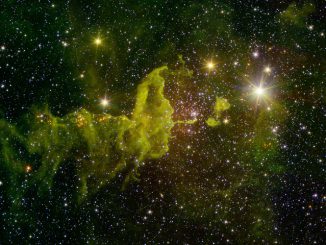
Spitzer sees a space spider watching over young stars

The “Spider Nebula” glows fluorescent green in an infrared image from NASA’s Spitzer Space Telescope and the Two Micron All Sky Survey (2MASS). Nebulae are clouds of interstellar gas and dust where stars can form. The Spider, officially named IC 417, is located about 10,000 light-years from Earth in the constellation Auriga.

News

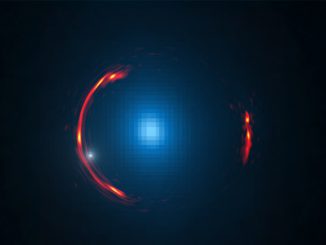
Dwarf dark galaxy hidden in ALMA gravitational lens image

Subtle distortions hidden in a stunning Atacama Large Millimetre/submillimetre Array (ALMA) image of the gravitational lens SDP.81 are telltale signs that a dwarf dark galaxy is lurking in the halo of a much larger galaxy nearly 4 billion light-years away. This discovery could help astronomers address important questions on the nature of dark matter.

Picture This

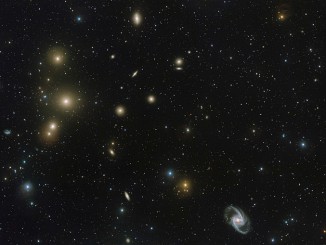
Gazing into the furnace: VST captures the Fornax Cluster

This new image from the VLT Survey Telescope (VST) at ESO’s Paranal Observatory in Chile captures a spectacular concentration of galaxies known as the Fornax Cluster, which can be found in the Southern Hemisphere constellation of Fornax (The Furnace). The cluster plays host to a menagerie of galaxies of all shapes and sizes, some of which are hiding secrets.