Picture This

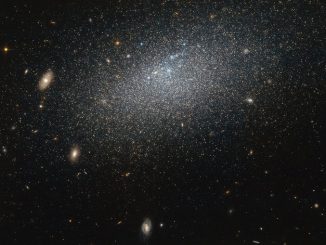
A mysterious solitary galaxy in Ursa Major

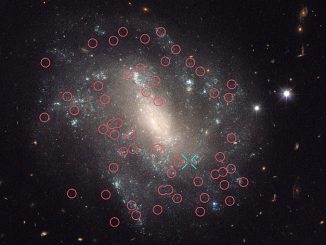
The drizzle of stars scattered across this image forms an irregular dwarf galaxy known as UGC 4879. Some 2.3 million light-years from its closest neighbour, UGC 4879’s isolation means that it has not interacted with any surrounding galaxies, making it an ideal laboratory for astronomers looking to understand the complex mysteries of starbirth throughout the universe.
Picture This

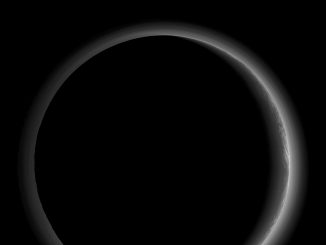
Pluto’s “Twilight Zone” reveals its secrets

NASA’s New Horizons spacecraft took this stunning image mere minutes after closest approach on 14 July 2015. Seen here, sunlight filters through and illuminates Pluto’s complex atmospheric haze layers over portions of the nitrogen ice plains informally named Sputnik Planum, as well as mountains of the informally named Norgay Montes.

News

Hubble finds universe is expanding faster than expected

When Edwin Hubble discovered nearly 100 years ago that the universe was uniformly expanding in all directions, the finding was a big surprise. Then, in the mid-1990s, another shocker occurred: astronomers found that the expansion rate was accelerating, perhaps due to “dark energy.” Now, the latest measurements of our runaway universe suggest that it is expanding faster than astronomers thought.

Picture This

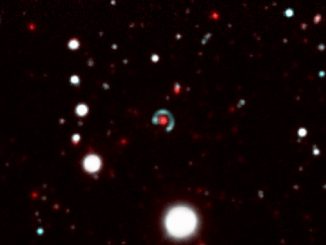
A new ‘Einstein ring’ is discovered

This unusual phenomenon, predicted by Einstein’s theory of General Relativity, was discovered by chance by doctoral student Margherita Bettinelli at the Instituto de Astrofísica de Canarias while analysing images of the Sculptor dwarf galaxy. The “Canarias Einstein ring” is one of the most symmetrical discovered until now and is almost circular.

News

How comets break up and make up

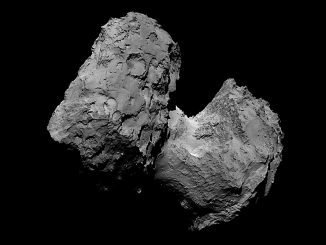
For some comets, breaking up is not that hard to do. A new study indicates that the bodies of some periodic comets — objects that orbit the Sun in less than 200 years — may regularly split in two, then reunite down the road. This may be a repeating process fundamental to comet evolution.

Picture This

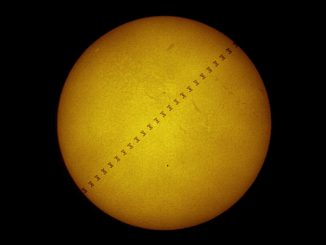
Mercury and International Space Station transit the Sun

French astrophotographer Thierry Legault travelled to the suburbs of Philadelphia, USA to capture both the International Space Station and planet Mercury transiting the Sun on 9 May. This image includes multiple stacked frames to show the Station’s path in the fraction of a second it took to cross the Sun, while Mercury appears as a black dot at bottom-centre.

News

Asteroids identified as source of Moon’s water

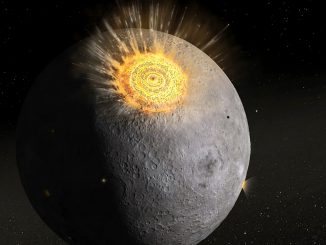
According to a new international study, most (>80 percent) of the water inside the Moon was delivered by asteroids similar to carbonaceous chondritic meteorites during the early lunar evolution, approximately 4.5—4.3 billion years ago. A similar delivery of water to the Earth would have been occurring within this same interval of time.

News

Did the young Sun steal Planet 9 from another star?

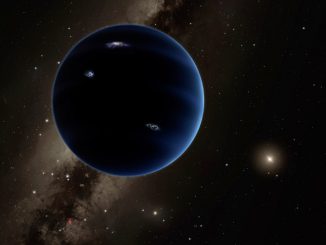
Through a computer-simulated study, astronomers at Lund University in Sweden show that it is highly likely the so-called Planet 9 is an exoplanet. This would make it the first such body to be discovered inside our own solar system — when or if it is found. The theory is that our Sun, in its youth some 4.5 billion years ago, stole Planet 9 from its original star.

Picture This

Hubble views heavy-metal stars

This 10.5-billion-year-old globular cluster, NGC 6496, is home to heavy-metal stars of a celestial kind! The stars comprising this spectacular spherical cluster are enriched with much higher proportions of metals (in astronomy, elements heavier than hydrogen and helium are curiously known as metals) than stars found in similar clusters.