Picture This

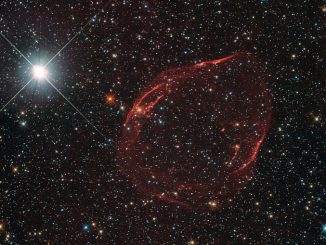
Hubble views supernova shrapnel

Several thousand years ago, a star some 160,000 light-years away from us exploded, scattering stellar shrapnel across the sky. The aftermath of this Type Ia supernova is shown here in this striking image from the NASA/ESA Hubble Space Telescope. The exploding star was a white dwarf located in the Large Magellanic Cloud, a close neighbouring galaxy.

News

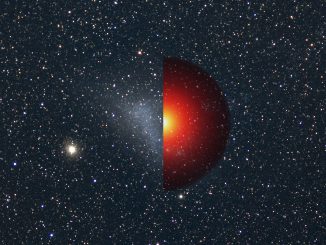
Fermi space telescope expands its search for dark matter

Dark matter, the mysterious substance that constitutes most of the material universe, remains as elusive as ever. Although experiments on the ground and in space have yet to find a trace of dark matter, six or more years of data from NASA’s Fermi Gamma-ray Space Telescope has broadened the mission’s dark matter hunt using some novel approaches.

News

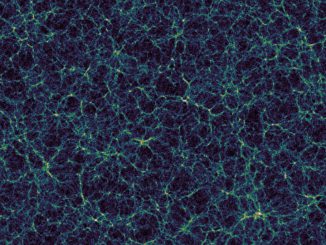
Astronomers use cosmic voids to study the universe

Researchers who are looking for new ways to probe the nature of gravity and dark energy in the universe have adopted a new strategy: looking at what’s not there. An international team of astronomers were able to achieve four times better precision in measurements of how the universe’s visible matter is clustered together by studying the empty spaces in between.

News

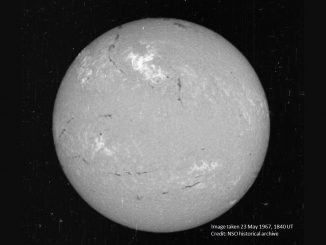
Solar storm of 1967 nearly took US to brink of war

The solar storm of 23 May 1967 that jammed radar and radio communications at the height of the Cold War could have led to a disastrous military conflict if not for the U.S. Air Force’s budding efforts to monitor the Sun’s activity, a new study finds. The ensuing geomagnetic storm was so strong that the northern lights were visible as far south as New Mexico.

Picture This

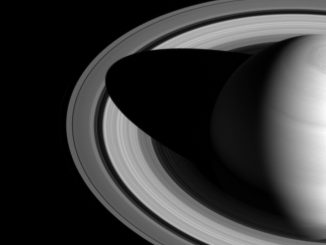
Saturn’s seasonal shadows

The shadow of Saturn’s globe on the rings, which stretched across all of the rings earlier in the Cassini spacecraft’s mission, now barely makes it past the Cassini Division. The changing length of the globe’s shadow marks the passing of the seasons on Saturn. As the planet nears its northern-hemisphere solstice in May 2017, the shadow will get even shorter.

Picture This

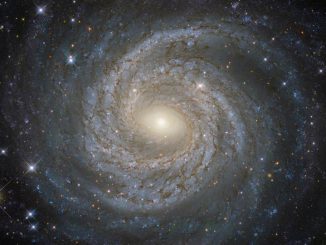
Hubble sees a lopsided lynx

This galaxy, known as NGC 2337, resides 25 million light-years away in the high northern constellation of Lynx. NGC 2337 is an irregular galaxy, meaning that it lacks a distinct, symmetrical appearance. The galaxy was discovered in 1877 by the French astronomer Édouard Stephan who, in the same year, discovered the galactic group Stephan’s Quintet.