Picture This

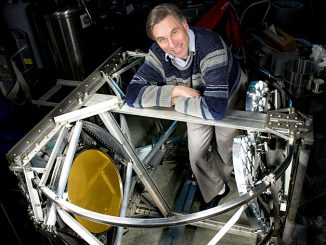
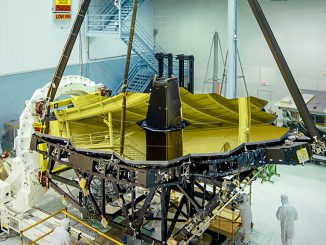
Golden eye: James Webb Space Telescope’s mirror unveiled

On 27 April 2016, engineers unveiled the giant golden mirror of NASA’s James Webb Space Telescope as part of the integration and testing of the infrared telescope. The 6.5-metre mirror is composed of 18 segments the size of a coffee table. Each is made from beryllium, weighs about 46 pounds (20 kg) and coated with vaporised gold to reflect infrared light.
News

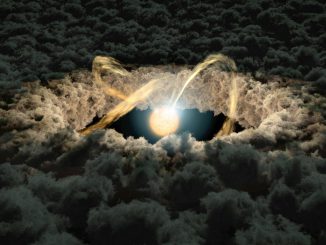
Light echoes give clues to young star’s protoplanetary disc

Protoplanetary discs are ‘doughnuts’ of gas and dust surrounding young stars, the sites where planets form over the course of millions of years. Researchers studying the one-million-year-old infant star YLW 16B, some 400 light-years from Earth, were able to determine the distance from the star to the inner rim of its surrounding protoplanetary disc by observing its light echo.

News

Hubble discovers moon orbiting the dwarf planet Makemake

NASA’s Hubble Space Telescope has spotted a small, dark moon orbiting Makemake, the second brightest icy dwarf planet — after Pluto — in the Kuiper Belt. The moon, provisionally designated S/2015 (136472) 1 and nicknamed MK 2, is estimated to be 100 miles in diameter. Makemake and its moon are more than 50 times farther away than Earth is from the Sun.

News

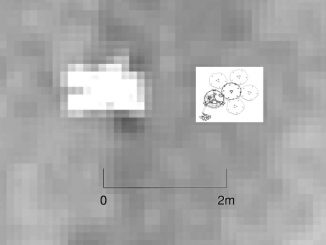
Martian surface revealed in unprecedented detail

The surface of Mars — including the location of Beagle-2 — has been shown in unprecedented detail by University College London scientists using a revolutionary image stacking and matching technique. The UCL researchers used the Super-Resolution Restoration (SRR) process to reveal objects at a resolution up to five times greater than previously achieved.

Picture This

Pluto’s mysterious ‘halo’ craters

Within Pluto’s informally named Vega Terra region is a field of eye-catching craters that looks like a cluster of bright haloes scattered across a dark landscape. NASA’s New Horizons spacecraft has revealed that the floors and terrain between the craters show signs of water ice, but exactly why bright methane ice settles on these crater rims and walls is a mystery.

Observing

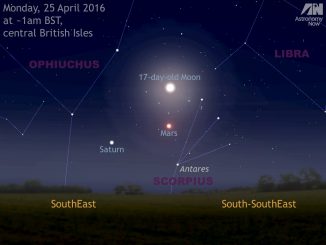
See the Moon join Mars and Saturn in the morning sky

With just a month to go until the 2016 opposition of Mars, the Red Planet is now visible very low in the southeast before midnight for observers in the heart of the UK. Mars and ringed planet Saturn are presently separated by just over 7 degrees — a low power, wide-angle binocular field of view. The waning gibbous Moon passes by on the mornings of 25—26 April.

Picture This

Herschel’s view of the Eagle Nebula

The Eagle Nebula, also known as Messier 16 (M16), as seen by ESA’s Herschel Space Observatory. A group of young, bright stars, not visible at these infrared wavelengths, are located near the centre of the image. The powerful light emitted by these stars is setting the surrounding gas ablaze, causing it to shine.