
Picture This



After a series of upgrades, the twin detectors of LIGO, the Laser Interferometer Gravitational-wave Observatory, have turned back on and resumed their search for ripples in the fabric of space and time known as gravitational waves. Now boasting a 25 percent improvement in sensitivity, LIGO recommenced science observations at 4pm GMT on 30 November.
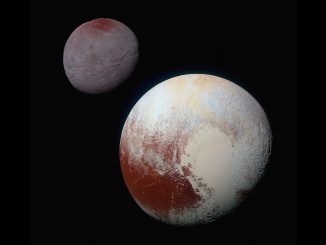
Pluto’s “icy heart” is a bright, two-lobed feature on its surface that was discovered by NASA’s New Horizons team in 2015. The heart’s western lobe, informally named Sputnik Planitia, is a deep basin generally thought to have been created by a smaller body striking Pluto at extremely high speed, but a new study suggests a different origin.

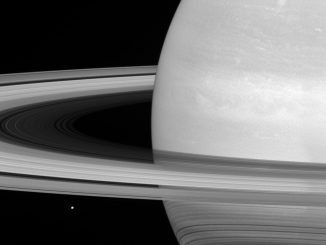
Saturn’s icy 246-mile-wide moon Mimas (near lower left) appears tiny by comparison to the planet’s rings, but scientists think the all of the small, icy particles spread over a vast area that comprise the rings are no more than a few times as massive as Mimas. The view was obtained by NASA’s Cassini spacecraft at a distance of approximately 564,000 miles from Saturn.
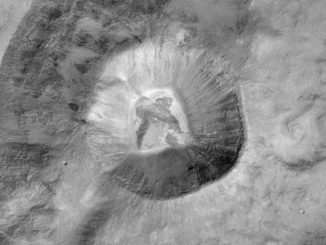
The Mars Camera, CaSSIS (Colour and Stereo Surface Imaging System), on ESA’s ExoMars Trace Gas Orbiter captured its first high-resolution images of the Red Planet last week. Developed by a team at the University of Bern in Switzerland, CaSSIS is providing spectacular views, including the Hebes Chasma region at a resolution of 2.8 metres per pixel.
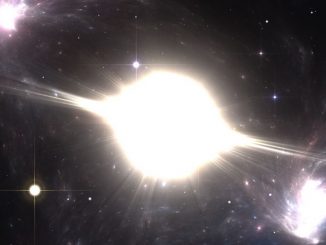
About 4.6 billion years ago, a cloud of gas and dust that eventually formed our solar system was disturbed. The ensuing gravitational collapse formed the proto-Sun with a surrounding disc where the planets were born. Now, forensic evidence from meteorites provides conclusive evidence that a low-mass supernova was the trigger.
© 2019 Pole Star Publications Limited