
Observing

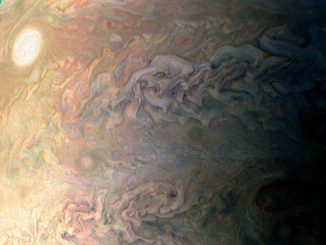
NASA’s Juno spacecraft made a high-speed pass less than 3,000 miles over Jupiter’s turbulent clouds Thursday, taking dozens of pictures, measuring radiation and plasma waves, and peering deep inside the planet’s atmosphere, but officials still have not cleared the orbiter’s main engine for a planned maneuver to position the probe for improved science observations.

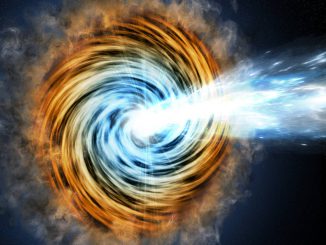
NASA’s Fermi Gamma-ray Space Telescope has identified the farthest gamma-ray blazars, a type of galaxy whose intense emissions are powered by supersized black holes. Light from the most distant object began its journey to us when the universe was 1.4 billion years old, or nearly 10 percent of its present age.

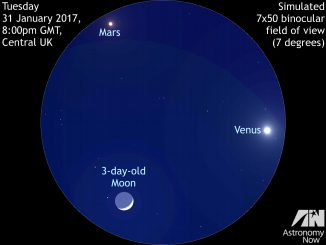
Dazzling Venus and much fainter Mars have a close encounter with a young Moon in the constellation of Pisces at UK dusk on Tuesday 31 January. The trio form an equilateral triangle small enough to be encompassed by the field of view of a 7x binocular low in the west-southwest for a couple of hours from 7pm GMT.
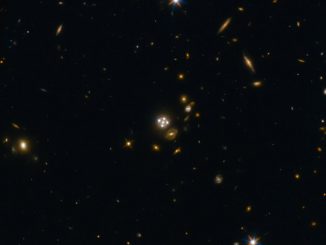
By using galaxies as giant gravitational lenses, an international group of astronomers using the Hubble Space Telescope have made an independent measurement of how fast the Universe is expanding. The newly measured expansion rate for the local Universe is consistent with earlier findings. These are, however, in intriguing disagreement with measurements of the early Universe.

© 2019 Pole Star Publications Limited