
News

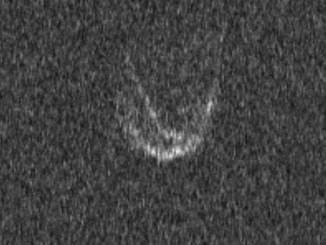
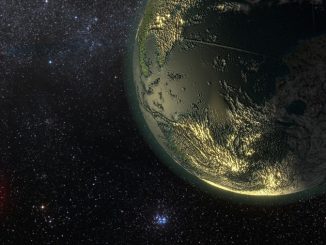
An international team of astronomers released the largest-ever compilation of exoplanet-detecting observations made using a technique called the radial velocity method. They demonstrated how these observations can be used to hunt for planets by detecting more than 100 potential exoplanets, including one orbiting the fourth-closest star to our own Solar System, which is about 8.1 light years away from Earth.
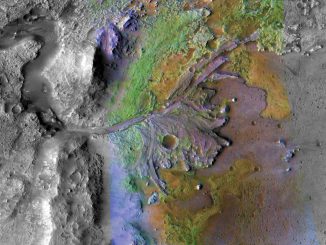
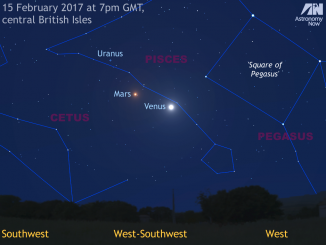
Currently setting over four hours after the Sun as seen from the heart of the UK and visible in the west-southwest at dusk, dazzling Venus is about to hit peak brightness in the constellation of Pisces. The planet attains magnitude -4.8 on Friday 17 February — some 21 times the luminosity of brightest star Sirius gracing the southeast horizon as darkness falls.

All known black holes fall into two categories: small, stellar-mass black holes weighing a few Suns, and supermassive black holes weighing millions or billions of Suns. Astronomers expect that intermediate-mass black holes weighing 100 – 10,000 Suns also exist, but so far no conclusive proof of such middleweights has been found. Astronomers have announced new evidence that an intermediate-mass black hole (IMBH) weighing 2,200 Suns is hiding at the center of the globular star cluster 47 Tucanae.

Comet 45P/Honda–Mrkos–Pajdušáková passes just 0.08318 astronomical units (7.73 million miles, or ~32 lunar distances) from Earth on the morning of 11 February. Early risers can catch the magnitude +7 comet speeding through the constellations of Hercules, Corona Borealis (CrB) and Boötes at up to 9 degrees/day.
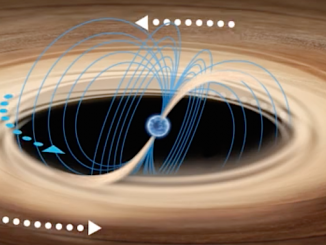
Scientists observing a curious neutron star in a binary system known as the ‘Rapid Burster’ may have solved a forty-year-old mystery surrounding its puzzling X-ray bursts. They discovered that its magnetic field creates a gap around the star, largely preventing it from feeding on matter from its stellar companion.

© 2019 Pole Star Publications Limited