
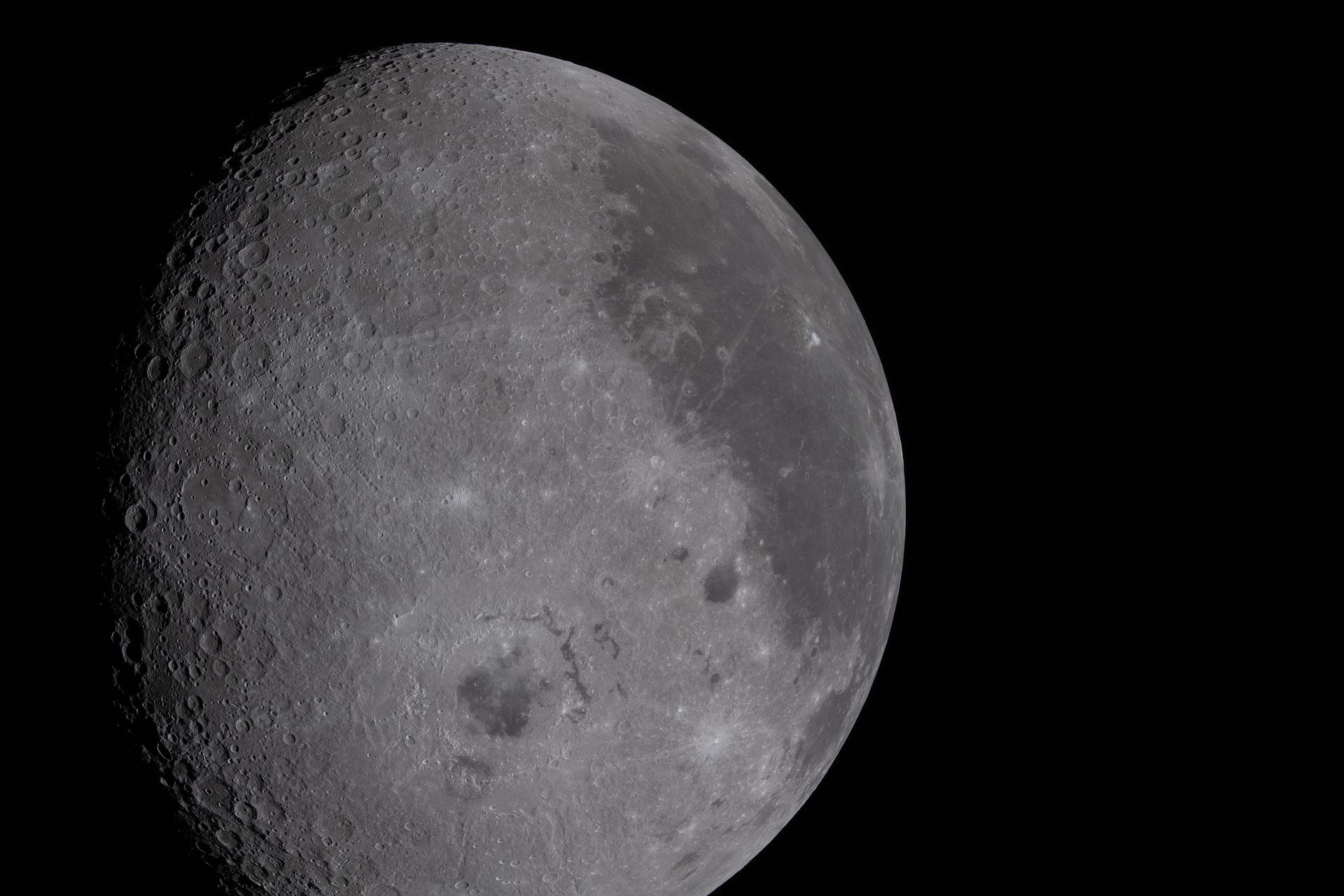
Humans have been deliberately crashing spacecraft into the Moon for more than 65 years, while nature has been targeting our natural satellite for billions. What makes today’s collision significant is the changing role of the Moon itself. In the near future, astronauts and landers, bases and even observatories will begin to occupy the lunar surface. That means uncontrolled lunar impacts will increasingly become a matter of safety, traffic management and scientific protection.
The discarded Falcon 9 upper stage that slammed into the Moon near Einstein crater today began its journey earlier this year, carrying Firefly Aerospace’s Blue Ghost lunar lander. Travelling at around 2.4 kilometres per second, the 13.8-metre-long stage was expected to excavate a crater a few tens of metres across. This is tiny by lunar standards, but the crater should later be identifiable by NASA’s Lunar Reconnaissance Orbiter.
Although such an impact may feel extraordinary, it belongs to a long tradition of human exploration.
The first spacecraft ever to reach another world, the Soviet Union’s Luna 2, did so by crashing into the Moon in September 1959. NASA’s Ranger probes followed the same philosophy during the early 1960s, transmitting ever more detailed images until their final, inevitable impacts. At a time when lunar soft landings had not yet been mastered, impacts were the only practical way to obtain close-up photographs of the surface.
Beyond pictures, scientists soon realised that impacts could become experiments in their own right. During the Apollo programme, NASA crashed several Saturn V upper stages into the lunar surface so that seismometers left behind by the astronauts could record the vibrations, allowing researchers to probe the Moon’s interior. With an impact mass of roughly 13–14 tonnes, these upper stages were about three times the mass of today’s Falcon 9 stage.
More recently, NASA’s LCROSS mission deliberately fired a spent Centaur rocket stage into the permanently shadowed Cabeus crater near the lunar south pole. The accompanying spacecraft flew through the debris plume, confirming that water ice and other volatile materials were present in the excavated material.
Other orbital missions subsequently disposed of in carefully planned crashes into the Moon include ESA’s SMART-1 spacecraft, NASA’s twin GRAIL orbiters and the LADEE mission. Nor is today’s accidental Falcon 9 impact unprecedented. In 2022, an old Chinese rocket stage struck the Moon’s far side. In both cases, the impending impact had been known for months.
Yet this catalogue of human impacts tells only part of the story. The Moon is continually bombarded by nature itself. The craters visible through even the simplest backyard telescopes were excavated by natural impactors over billions of years. Smaller impacts continue constantly today.
Without a substantial atmosphere to burn up incoming objects, even relatively small rocks strike the surface at cosmic speeds, producing brief flashes that are routinely monitored by astronomers. In recent months, the Artemis astronauts circling the Moon also reported seeing several probable impact flashes on the lunar night side.
Other, more dramatic sightings date back centuries. In 1178, the monk Gervase of Canterbury recorded an account of flames apparently erupting from the Moon’s crescent. For many years it was suggested that this marked the formation of Giordano Bruno crater. Modern studies, however, show that explanation is almost certainly incorrect, and what the witnesses saw remains uncertain.
So, if natural and artificial impacts are so common, why has this week’s Falcon 9 collision attracted so much attention?
Beyond the inevitable interest attracted by anything associated with SpaceX, the answer is that the Moon itself is changing.
For most of the Space Age, the lunar surface was effectively empty. A new crater simply joined billions of old ones on the barren surface. Today, however, the Moon is poised to become an operational environment.
Multiple nations are planning sustained exploration around the south pole. Commercial landers could soon routinely ferry scientific equipment and other cargo to the surface. Future observatories may seek out the radio silence of the lunar far side or the natural cold of permanently shadowed craters.
Future collisions could disturb scientifically valuable sites, throw abrasive dust across nearby instruments or complicate the management of an increasingly busy lunar environment. They could also pose a danger to astronauts and their bases.
As Astronomy Now explored in this month’s feature on lunar astronomy, protecting future observatories may eventually require designated disposal zones, traffic management and internationally agreed scientific preserves.
In that sense, today’s Falcon 9 impact highlights an important shift in humanity’s relationship with the Moon. We have always crashed things into our nearest neighbour. Now, however, we can no longer do so without considering what lies beneath or nearby.
Read more about lunar space debris and its potential impact on astronomy in the August issue of Astronomy Now. Instant access available via the Astronomy Now archive app subscription or one-off digital issue purchase.