Venus is seen next to the crescent moon during the daytime, prior to the start of occultation, on 7 December 2015 in Washington, D.C. in the United States. The moon occulted, or passed in front of, Venus for the second time this year.

Venus is seen next to the crescent moon during the daytime, prior to the start of occultation, on 7 December 2015 in Washington, D.C. in the United States. The moon occulted, or passed in front of, Venus for the second time this year.
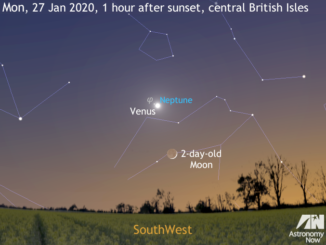
Even casual skywatchers cannot fail to notice brightest planet Venus currently hanging like a lantern above the southwest horizon at dusk. But as Venus moves eastwards through Aquarius on successive nights, it draws closer to outermost (and faintest) planet Neptune until the pair reach a particularly close conjunction on the UK evening of Monday, 27 January.
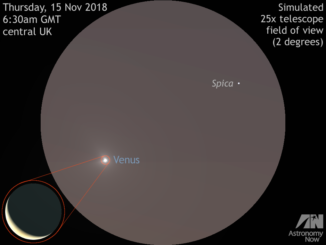
Find a location that offers you an unobstructed view of the southeast about an hour before sunrise in the UK over the next week to see dazzling Venus close to the horizon. Look carefully at the planet around 6:30am GMT on 15 November and you’ll see it close to first-magnitude Spica, Virgo’s brightest star.
© 2026 Nebula Press Ltd