
Venus is seen next to the crescent moon during the daytime, prior to the start of occultation, on 7 December 2015 in Washington, D.C. in the United States. The moon occulted, or passed in front of, Venus for the second time this year.

Venus is seen next to the crescent moon during the daytime, prior to the start of occultation, on 7 December 2015 in Washington, D.C. in the United States. The moon occulted, or passed in front of, Venus for the second time this year.

On Sunday, 29 March around civil dusk, observers throughout the British Isles with suitably steadied binoculars and small telescopes can watch naked-eye star Epsilon (ε) Tauri disappear behind the darkened hemisphere of the almost 5-day-old waxing crescent Moon, reappearing again slightly more than an hour later. Here’s our where and when guide to viewing it.
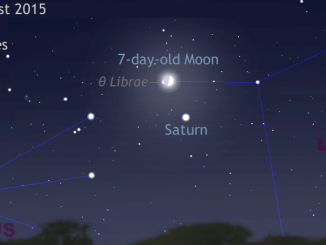
As dusk fades to dark on Saturday, 22 August, observers in the British Isles and Western Europe with clear skies can see the first quarter Moon close above planet Saturn low to the southwest. But for those skywatchers with binoculars and small telescopes, an additional treat is in store as the Moon passes in front of (occults) a naked-eye star.
© 2019 Pole Star Publications Limited
