3 December 2025
Astronomy Now
  • Home
  • The Magazine
    • About
    • Current Issue
    • Subscribe
    • Renew Subscription
      • September last issue
      • August last issue
      • July last issue
  • AstroFest 2026
  • News
  • Observing
    • UK Sky Chart
    • Almanac
    • Scope Calc
    • DSLR Calc
  • Reviews
    • Equipment
    • Book Reviews
  • Spaceflight Now
  • Shop
  • Contact Us
    • Subscriptions
    • Your Views
    • Ask Astronomy Now
    • Editorial
    • Advertising
    • AstroListings
Latest News
  • [ 29 October 2025 ] How to see Comet Lemmon News
  • [ 25 October 2025 ] Hubble revisits a cosmic yardstick News
  • [ 21 October 2025 ] Europe’s planet hunting spacecraft complete and ready for final testing News
  • [ 24 September 2025 ] Nova outburst in Centaurus News
  • [ 12 September 2025 ] Astronomy Now relaunches digital platform News
  • Twitter
  • Facebook

Professor Mark Sims on the discovery that Beagle 2 made it to the surface

16 January 2015 Astronomy Now

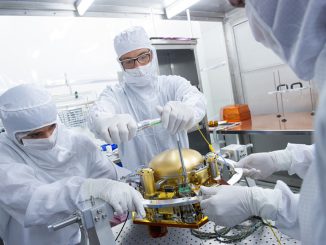
Professor Mark Sims of Leicester University speaks to Astronomy Now’s Keith Cooper on the discovery that Beagle 2 made it to the surface on Christmas Day 2003.

Read our full story on the new images of Beagle 2.

  • Beagle 2
  • Mars

Related Articles

Observing

See the Moon, Mars and Saturn triple conjunction of 1 March

29 February 2016 Ade Ashford

In the pre-dawn twilight of Tuesday, 1 March, the 21-day-old waning gibbous Moon acts as a convenient celestial guide to planets Saturn and Mars. For observers in the centre of the British Isles, the best time to see this triple conjunction is shortly before 6am GMT, when the trio are highest in the sky to the south.

News

Mars will gain a ring as Phobos has only 40 million years left

25 November 2015 Keith Cooper

The red planet Mars is destined to become the ringed planet within 40 million years’ time, when its largest moon Phobos is torn apart, according to two scientists from the University of California, Berkeley.

Observing

See the Moon join Mars and Saturn in the morning sky

23 April 2016 Ade Ashford

With just a month to go until the 2016 opposition of Mars, the Red Planet is now visible very low in the southeast before midnight for observers in the heart of the UK. Mars and ringed planet Saturn are presently separated by just over 7 degrees — a low power, wide-angle binocular field of view. The waning gibbous Moon passes by on the mornings of 25—26 April.

Astronomy Now NewsAlert

Get the latest astronomical news and stargazing tips delivered to your inbox.

News Headlines

  • How to see Comet Lemmon
    29 October 2025
  • Hubble revisits a cosmic yardstick
    25 October 2025
  • Europe’s planet hunting spacecraft complete and ready for final testing
    21 October 2025
  • Nova outburst in Centaurus
    24 September 2025
  • Astronomy Now relaunches digital platform
    12 September 2025
  • Home
  • The Magazine
    • About
    • Current Issue
    • Subscribe
    • Renew Subscription
      • September last issue
      • August last issue
      • July last issue
  • AstroFest 2026
  • News
  • Observing
    • UK Sky Chart
    • Almanac
    • Scope Calc
    • DSLR Calc
  • Reviews
    • Equipment
    • Book Reviews
  • Spaceflight Now
  • Shop
  • Contact Us
    • Subscriptions
    • Your Views
    • Ask Astronomy Now
    • Editorial
    • Advertising
    • AstroListings

© 2019 Pole Star Publications Limited

Astronomy Now