Observing

See planet Venus hit peak brightness in the evening sky

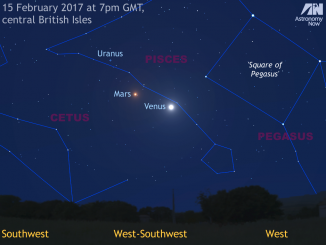
Currently setting over four hours after the Sun as seen from the heart of the UK and visible in the west-southwest at dusk, dazzling Venus is about to hit peak brightness in the constellation of Pisces. The planet attains magnitude -4.8 on Friday 17 February — some 21 times the luminosity of brightest star Sirius gracing the southeast horizon as darkness falls.
Observing

See the Mars-Venus-Moon conjunction of 31 January

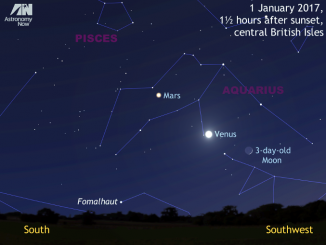
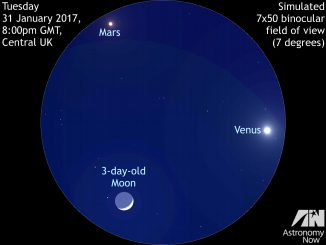
Dazzling Venus and much fainter Mars have a close encounter with a young Moon in the constellation of Pisces at UK dusk on Tuesday 31 January. The trio form an equilateral triangle small enough to be encompassed by the field of view of a 7x binocular low in the west-southwest for a couple of hours from 7pm GMT.

News

Mars rover’s drill out of action

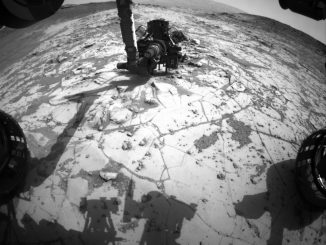
The rock-coring drill fixed to the end of the Curiosity rover’s robot arm has suspended operations to allow engineers on the ground to diagnose, and officials hope correct, a problem traced to the mechanism that pushes the drill bit onto rocks to collect powder samples.

News

CaSSIS sends first images from Mars orbit

The Mars Camera, CaSSIS (Colour and Stereo Surface Imaging System), on ESA’s ExoMars Trace Gas Orbiter captured its first high-resolution images of the Red Planet last week. Developed by a team at the University of Bern in Switzerland, CaSSIS is providing spectacular views, including the Hebes Chasma region at a resolution of 2.8 metres per pixel.

Observing

Catch Mars and Venus in the early evening sky of late November

Find a location that offers you an unobstructed view of the horizon from south to southwest an hour after sunset. With clear skies, you’ll be able to follow Venus and Mars from night to night on their celestial peregrinations through the constellations of Sagittarius and Capricornus. The two planets almost keep pace with each other throughout the remainder of November.