News

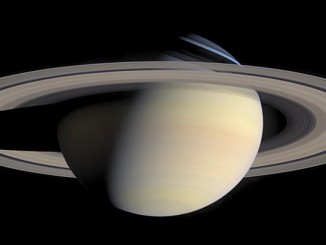
Saturn’s rings: less than meets the eye?

You might think that, in the rings of Saturn, more opaque areas contain a greater concentration of material than places where the rings seem more transparent. But this intuition does not always apply, according to a recent study of the rings using data from NASA’s Cassini mission. The research also suggests that the planet’s brightest B ring could be a few hundred million years old instead of a few billion.

News

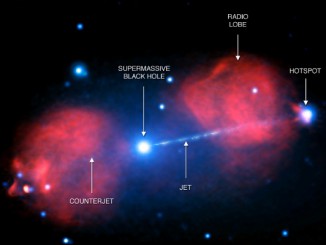
Blast from black hole in distant Pictor A galaxy

By combining X-ray data from NASA’s Chandra X-ray Observatory over a 15-year period with radio data from the Australia Telescope Compact Array, astronomers have a better understanding of the active galaxy Pictor A, the supermassive black hole at its core and the enormous jet of particles it generates travelling at nearly the speed of light into intergalactic space.

News

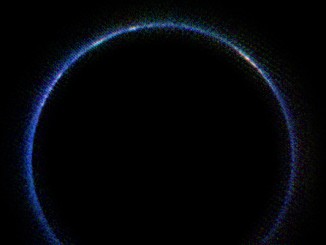
Pluto’s blue atmospheric ring in the infrared

A new image from NASA’s New Horizons spacecraft is the first look at Pluto’s atmosphere in infrared wavelengths, and the first image of the atmosphere made with data from the probe’s LEISA instrument. The blue ring around Pluto is caused by sunlight scattered from a haze of hydrocarbon particles in the form of a photochemical smog.

Picture This

The unearthly beauty of the Red Rectangle

Straight lines do not often crop up in space. Whenever they do, they seem somehow incongruous and draw our attention. The Red Rectangle, a so-called planetary nebula surrounding the double star HD 44179 some 2300 light-years away in the constellation of Monoceros, is one such mystery object.

Picture This

Hubble sees starburst in the maelstrom of a galactic merger

This Hubble image is of the peculiar galaxy NGC 1487, lying about 30 million light-years away. We are witnessing the possible merger of several dwarf galaxies into a new single galaxy. Its appearance is dominated by large areas of bright blue stars, illuminating the patches of gas that gave them life. This burst of star formation may well have been triggered by the merger.

News

Phase of the Moon affects amount of rainfall

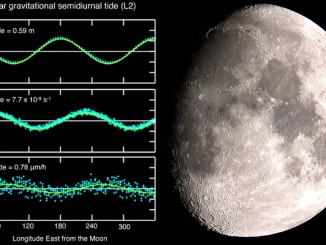
When the Moon is high in the sky, it produces bulges in the Earth’s atmosphere that create measurable changes in the amount of rain that falls below, according to new research. But no-one should carry an umbrella just because the Moon is rising — even in the tropics, average rainfall rates are only increased by 1/10,000 of an inch per hour.

News

Understanding the magnetic Sun

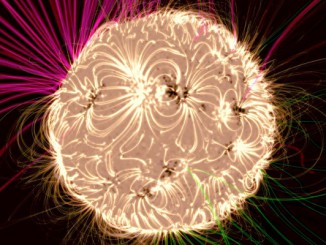
The Sun’s magnetic field is responsible for everything from the solar explosions that cause space weather on Earth — such as aurorae — to the interplanetary magnetic field and radiation through which our spacecraft journeying around the solar system must travel. But even now, scientists are not sure exactly where in the Sun the magnetic field is created.

News

New Horizons reveals Pluto’s widespread water ice

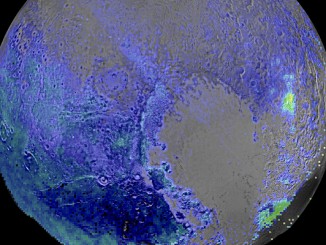
Data from NASA’s New Horizons spacecraft point to more prevalent water ice on Pluto’s surface than previously thought. Water ice is Pluto’s crustal “bedrock,” the canvas on which its more volatile ices paint their seasonally changing patterns. The new false-colour image is derived from observations in infrared light by the probe’s Ralph/Linear Etalon Imaging Spectral Array.