
Picture This


Researchers have identified a young star, located almost 11,000 light-years away, which could help us understand how the most massive stars in the universe are formed. This star, already more than 30 times the mass of our Sun, is still in the process of gathering material from its parent molecular cloud, and may be even more massive when it finally reaches adulthood.

This NASA/ESA Hubble Space Telescope image captures the glow of distant stars within NGC 5264, a dwarf galaxy located just over 15 million light-years away in the constellation of Hydra (The Sea Serpent). NGC 5264 clearly possesses an irregular shape — unlike the more common spiral or elliptical galaxies — with knots of blue star formation.

Watch as NASA holds a news conference at its Washington, D.C. headquarters to provide a preview of its OSIRIS-REx mission to asteroid Bennu and back. The mission is scheduled to launch on 8 September, reach the asteroid in 2018, capture a sample of the celestial body in 2020 and bring the specimen back to Earth in a special landing capsule in 2023.


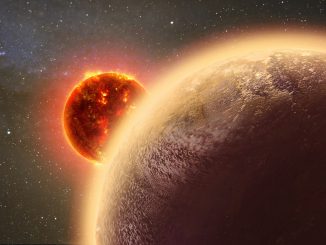
The distant planet GJ 1132b intrigued astronomers when it was discovered last year. Located just 39 light-years from Earth and orbiting its red dwarf star every 1.6 days, new research shows that despite being baked to a temperature of around 232 °C, GJ 1132b might possess a thin, oxygen atmosphere — but no life due to its extreme heat.

For the first time, astroarchaeologists have statistically proven that the earliest standing stone monuments of Britain — the great circles — were constructed specifically in line with the movements of the Sun and Moon, 5000 years ago. University of Adelaide researchers used innovative 2-D and 3-D technology to test the patterns of alignment in the standing stones.
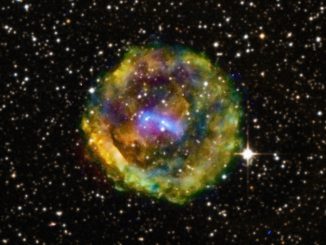
A new look at the debris from an exploded star in our galaxy has astronomers re-examining when the supernova actually happened. Recent observations of the supernova remnant called G11.2-0.3 with NASA’s Chandra X-ray Observatory have stripped away its connection to an event recorded by the Chinese in 386 CE.
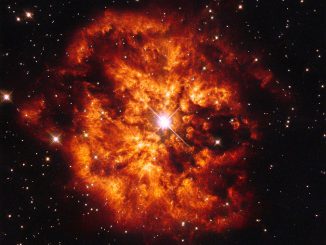
In this NASA/ESA Hubble Space Telescope image we see the central Wolf-Rayet star known as Hen 2-427 — more commonly known as WR 124 — surrounded by the nebula M1-67. Both objects are found in the constellation of Sagitta some 15,000 light-years away. The hot clumps of gas ejected by the star into space are travelling at over 150,000 kilometres per hour.
© 2019 Pole Star Publications Limited