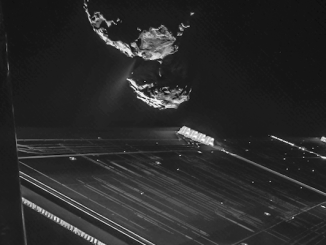
Paolo Ferri, ESA’s Head of Mission Operations, expresses relief at the apparently successful release of Philae from the Rosetta mothership but the potential loss of a crucial touchdown system has caused increased anxiety about the landing.
Related Articles
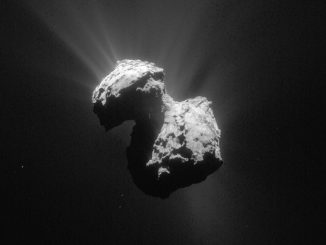
How Rosetta’s comet got its shape
The origin of of Comet 67P/Churyumov-Gerasimenko’s double-lobed form has been a key question since Rosetta first revealed its surprising shape in July 2014. By studying the layers of material seen all over the nucleus, scientists have shown that the shape arose from a low-speed collision between two fully fledged, separately formed comets.
See Comet 45P’s close brush with Earth in the pre-dawn sky
Comet 45P/Honda–Mrkos–Pajdušáková passes just 0.08318 astronomical units (7.73 million miles, or ~32 lunar distances) from Earth on the morning of 11 February. Early risers can catch the magnitude +7 comet speeding through the constellations of Hercules, Corona Borealis (CrB) and Boötes at up to 9 degrees/day.
Astronomers predict possible birthplace of Rosetta-probed comet 67P
Canadian researchers have charted a path that most likely pinpoints the very origins of 67P/Churyumov-Gerasimenko, the comet studied intensively by ESA’s Rosetta spacecraft. Western University astronomers believe that 67P is made from primordial material and relatively new to the inner parts of our solar system, having only arrived about 10,000 years ago.