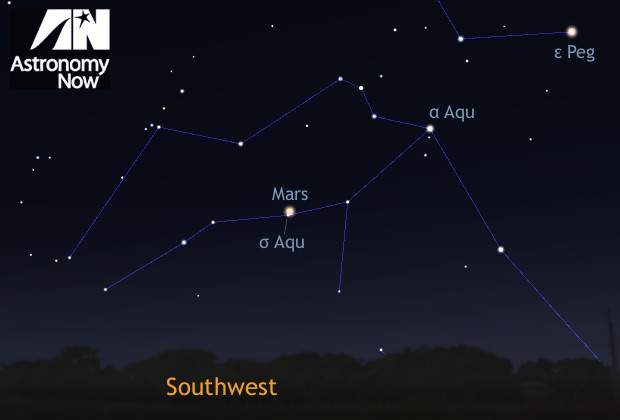
This is the view low to the southwest at 6 pm GMT on 19th January as seen from the UK, the night that Mars is closest to fainter and much more distant planetary sibling Neptune. To the naked eye, magnitude +1.4 Mars will lie about the span of an outstretched hand at arm’s length above the horizon, the brightest object in the area. AN graphic by Ade AshfordNovice observers wishing to see outermost planet Neptune with small telescopes often have difficulty locating it, not because it’s excessively faint — slightly brighter than magnitude +8, so 10×50 binoculars will reveal it under dark, moonless skies — but due to its star-like appearance. Higher magnifications will reveal its pale blue 2.2-arcsecond disc, distinguishing it from background stars of similar brightness. However, a very convenient celestial marker in the form of a close conjunction with planetary sibling Mars makes locating Neptune very easy in a telescope on Monday, 19th January.
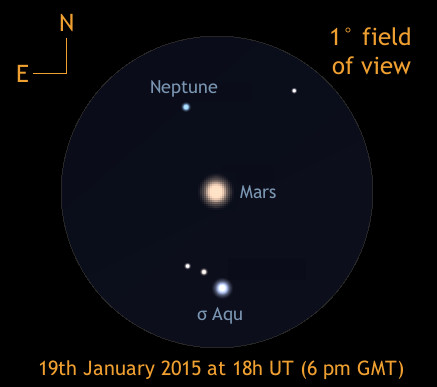
This one-degree-wide view centred on Mars at 6 pm on 19th January shows the field stars around Neptune that you will see in a low-power telescope field as an aid to identification. While Mars will only be in this position for the night of the 19th, Neptune will lie 0.6° — slightly more than the diameter of the Full Moon — north of magnitude +4.8 naked-eye star sigma (σ) Aquarii for several nights. AN graphic by Ade AshfordSet against the constellation backdrop of Aquarius low to the southwest at the time of their closest approach — which is, of course, a line of sight effect — Mars will be 2.06 astronomical units (191 million miles; 307 million km.) distant and displaying a tiny 4.6-arcsecond gibbous disc, while Neptune is a colossal 30.75 AU (2859 million miles) away!
Observers in the British Isles should have their binoculars or telescopes setup facing an unobscured southwest horizon by 5:30 pm GMT as twilight fades enough for the stars to be visible. As you observe this planetary juxtaposition with an angular separation of just ¼° in the eyepiece, contemplate the contrast in physical makeup of these two worlds — Mars is rocky and more Earth-like though half the size of our planet, while Neptune is gaseous and four times the size of Earth.
For an even greater image contrast, brilliant Venus also passes just ¾° away from Neptune on the evening of February 1st. More on that next month.
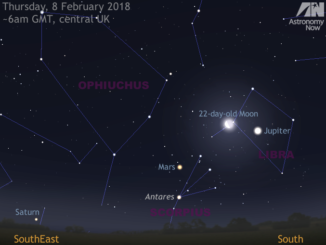
Set your alarm for 6am GMT if you wish to see three naked-eye planets in the UK dawn sky this week. Find a location that offers an unobstructed view of the horizon from southeast to south and let the waning Moon be your guide to locating Jupiter, Mars and Saturn on successive mornings from 7 to 11 February.
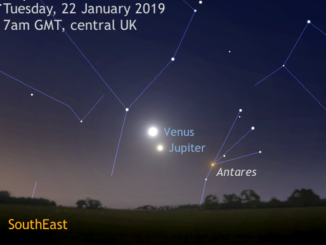
Observers in Western Europe with a clear view to the south-southeast at nautical dawn can watch the changing configuration two prominent naked-eye planets over the next few mornings, culminating in a beautiful close conjunction of Venus and Jupiter on 22 January 2019.
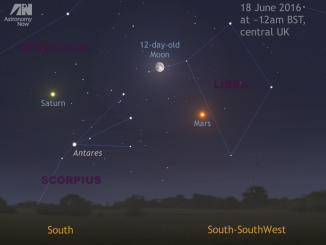
We may be losing Jupiter in the west at dusk, but two other planets are well placed in the late evening. Skywatchers in the UK and Western Europe should look low in the southern sky around 12am local time on 17, 18 and 19 June to see the waxing gibbous Moon in the vicinity of planets Mars and Saturn, plus first-magnitude star Antares in the constellation of Scorpius.