
Tim Peake sees the city lights of his capital city burning bright from the International Space Station last night. He tweeted: “London midnight Saturday – I’d rather be up here…but only just!!”

Tim Peake sees the city lights of his capital city burning bright from the International Space Station last night. He tweeted: “London midnight Saturday – I’d rather be up here…but only just!!”
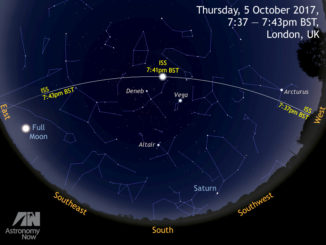
Urban dwellers may resign themselves to spotting the Moon, planets and the brightest stars with the unaided eye on a clear night, but every so often a bright satellite will catch your attention as it glides silently across the sky. The brightest is the 400-tonne International Space Station (ISS) whose orbit carries it directly overhead as seen from the British Isles and parts of Western Europe tonight.

Have you ever seen the International Space Station (ISS)? It’s capable of exceeding Venus at its brightest and visible for up to 7 minutes as it crawls across the sky in an arc from west to east. Find out when and where to see some favourable passes of this 450-tonne, 109-metre-long spacecraft over the British Isles and Western Europe this week.
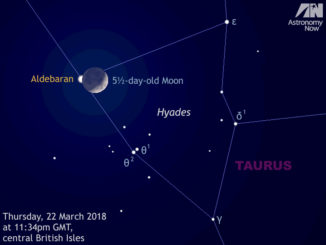
On Thursday, 22 March observers in the British Isles with clear skies can see the 5½-day-old setting crescent Moon pass in front of first-magnitude star Aldebaran in the constellation of Taurus soon after 11:30pm GMT. Depending on where you live in the UK, you might just see the star reappear again shortly before the pair set.
© 2019 Pole Star Publications Limited