4 February 2026
Astronomy Now
  • Home
  • The Magazine
    • About
    • Current Issue
    • Subscribe
    • Renew Subscription
      • September last issue
      • August last issue
      • July last issue
  • AstroFest 2026
  • News
  • Observing
    • UK Sky Chart
    • Almanac
    • Scope Calc
    • DSLR Calc
  • Reviews
    • Equipment
    • Book Reviews
  • Spaceflight Now
  • Shop
  • Contact Us
    • Subscriptions
    • Your Views
    • Ask Astronomy Now
    • Editorial
    • Advertising
    • AstroListings
Latest News
  • [ 26 January 2026 ] Dr Allan Chapman (1946-2026) News
  • [ 16 January 2026 ] Potentially bright ‘sungrazing’ comet discovered News
  • [ 17 December 2025 ] Thank you from the editor News
  • [ 25 October 2025 ] Hubble revisits a cosmic yardstick News
  • [ 21 October 2025 ] Europe’s planet hunting spacecraft complete and ready for final testing News
  • Facebook
  • Twitter
  • LinkedIn

Year: 2015

News

Dark energy explained by relativistic time dilation?

5 January 2015 Astronomy Now

Dark energy is proposed to drive the accelerated expansion of the universe, but a new study suggests that changing how we think about time dilation in relation to gravity as predicted by Albert Einstein can provide an alternate explanation.

Observing

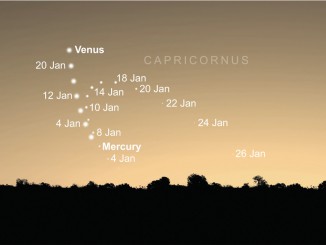
Elusive Mercury and dazzling Venus together as evening stars

2 January 2015 Mark Armstrong

Inner planets Mercury and Venus are currently approaching conjunction, low to the southwest horizon shortly after sunset. If you have an extra clear sky, then Mars completes the scene.

Observing

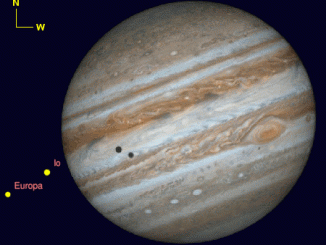
Jupiter’s moon events enthral observers

2 January 2015 Ade Ashford

The continued edgewise orbital aspect of Jupiter’s large moons Io, Europa, Ganymede and Callisto means that they still regularly eclipse and occult each other. Multiple shadow transits also continue throughout January.

News

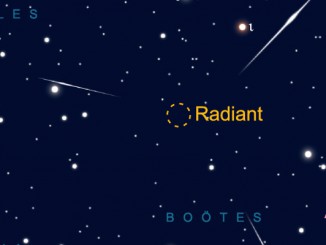
Don’t miss the Quadrantid meteor shower

2 January 2015 Mark Armstrong

The first shooting stars of 2015 belong to the the Quadrantids, a shower that peaks on the night of 3rd/4th January. Despite the interference of a gibbous Moon, expect some bright, sometimes blue and yellow coloured meteors that may leave glowing trails.

News

Dawn begins final approach to dwarf planet Ceres

1 January 2015 Stephen Clark

NASA’s Dawn spacecraft has begun its final approach to the dwarf planet Ceres, the largest object in the asteroid belt, for an in-depth survey of the uncharted world.

Posts pagination

« 1 … 77 78

Astronomy Now NewsAlert

Get the latest astronomical news and stargazing tips delivered to your inbox.

News Headlines

  • Dr Allan Chapman (1946-2026)
    26 January 2026
  • Potentially bright ‘sungrazing’ comet discovered
    16 January 2026
  • Thank you from the editor
    17 December 2025
  • Hubble revisits a cosmic yardstick
    25 October 2025
  • Europe’s planet hunting spacecraft complete and ready for final testing
    21 October 2025

© 2019 Pole Star Publications Limited

Astronomy Now