News

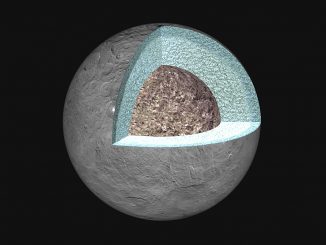
By tracking subtle changes in the motion of NASA’s Dawn spacecraft, scientists have mapped the variations in Ceres’ gravity for the first time, providing clues to the dwarf planet’s internal structure. The new data suggest that Ceres has a weak interior, and that water and other light materials partially separated from rock during a heating phase early in its history.
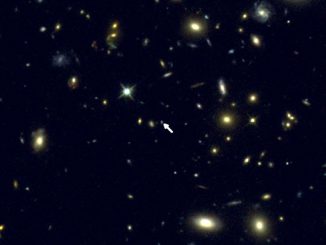
Astronomers have made the first accurate measurement of the abundance of oxygen in a distant galaxy. Oxygen is created inside stars and released into interstellar gas when stars die. Quantifying the amount of oxygen, the third-most abundant chemical element in the universe, is key to understanding how matter cycles in and out of galaxies.
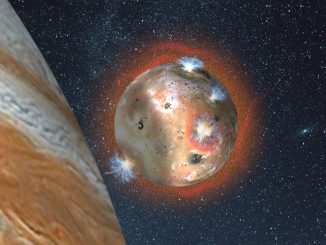
A team of scientists has documented atmospheric changes on Io, Jupiter’s volcanically active satellite, as the giant planet casts its shadow over the moon during daily eclipses. Io’s thin atmosphere collapses as the sulfur dioxide gas emitted from volcanoes freezes when shaded by Jupiter. The atmosphere reforms when Io moves out of eclipse and the ice sublimates.
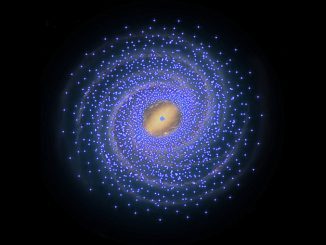
A major revision is required in our understanding of the Milky Way Galaxy according to an international team led by Professor Noriyuki Matsunaga of the University of Tokyo. The Japanese, South African and Italian astronomers found a huge region around the centre of our own galaxy which is devoid of young stars.

The universe is 13.8 billion years old, while our planet formed just 4.5 billion years ago. Some scientists think this time gap means that life on other planets could be billions of years older than ours. However, new theoretical work suggests that present-day life is actually premature from a cosmic perspective.

Supermassive black holes do not give off any of their own light, hence the word “black” in their name. However, many black holes pull in surrounding material and emit powerful bursts of X-rays. Collectively, these active black holes can be thought of a cosmic choir, singing in the language of X-rays. Their “song” is what astronomers call the cosmic X-ray background.

New findings using data from NASA’s Mars Reconnaissance Orbiter show that gullies on modern Mars are likely not being formed by flowing liquid water. This new evidence will allow researchers to further narrow theories about how Martian gullies form, and reveal more details about Mars’ recent geologic processes.
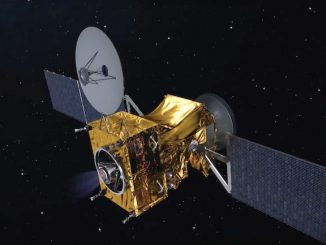
A European spacecraft cruising toward Mars fired its main engine, tweaking its trajectory and helping set up for carefully-choreographed simultaneous maneuvers to place part of the tandem mission into orbit around the red planet and deposit a stationary battery-powered lander on the Martian surface.
© 2026 Nebula Press Ltd