

1–7 June 2009
What's up this week? Our weekly guide to the night sky will point you to all the planetary goings on, as well as pick out some deep sky objects for your viewing pleasure. Let's get started with a round-up of the Solar System, or follow the links above to jump to your favourite section.
Solar System Round-Up
June is regarded by some amateurs as a month for shutting down the observatory and giving the telescope a well-earned service. For many parts of the country the sky remains too light for many aspects of observing; consider observers in Skaw, on the Shetland island of Unst, the UK’s northernmost settlement. The Sun barely dips six degrees below the northern horizon, so strong twilight blights the short nights this week and it won’t be until late August that dark skies once again prevail. Even from mainland UK’s southernmost point, the Lizard Peninsula in Cornwall, the sky is not truly dark, as the Sun never dips more than 18 degrees below the horizon; at least astronomical twilight persists for part of the short nights. That said, lunar and planetary observing can still be enjoyable and rewarding, as can keeping a close watch on the Sun for any sights of activity.
Saturn
The sky is dark enough, at least from more southerly regions of the UK, to start observing by 11:30pm. Saturn is the only planet in the sky, but it is gradually sinking in the western sky and is barely 20 degrees up; it sets at around 2am this week so catch it early. Its low altitude will more than likely mean poor seeing will preclude any meaningful observations but Titan, its giant moon, can be seen with large binoculars. This week it reaches greatest western elongation, almost three arcminutes from Saturn’s limb, on the night of 3/4 June.
Jupiter
Jupiter rises shortly after 1am by the end of the week, but is frustratingly low in the south-eastern morning sky when the skies start to lighten by 2:30am. If you have an unobstructed horizon in this direction and can observe with a moderately large telescope, then it might be possible to see a few Galilean satellite events. During this Jovian apparition there are many so-called mutual events visible all around the world. Jupiter’s southerly declination means opportunities for UK observers are few and far between. However, on 2 June between 2:50am and 3:04am Callisto eclipses Europa. Train your telescope on Europa and you should see the moon fade down by the predicted 1.56 magnitudes. A couple of ‘ordinary’ phenomena might be observable too; on 5 June at 2:35am Io reappears from behind the gas giant’s eastern limb and Ganymede does the same on the next day at 2:30am.
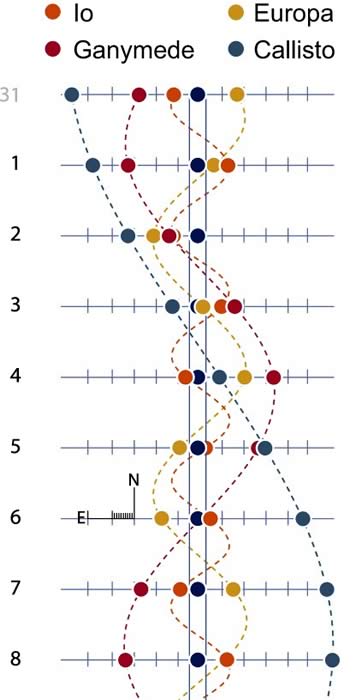
Follow Jupiter's moons for the first week of June. AN graphic by Greg Smye–Rumsby.
Planets round-up
Venus and Mars are close together in the eastern morning sky, but a clear horizon will be needed to spot them, as both are under ten degrees elevation. Uranus is steadily climbing out of the morning murk and should be visible in binoculars, just over four degrees south of magnitude +4.5 lambda Piscium. Neptune is within three quarters of a degree of Jupiter all week, and this, together with its bluish colour, should make it an easy spot in small telescopes.
The Moon
The Moon shows a waxing, gibbous phase this week, on its way to full on 7 June. Along with everything else this week, it never gets that high in the sky but there are great lunar landmarks on show. On 1 June the dark-floored crater Plato, with the striking peaks of Montes Tenerife just to its south, are basking in the sunlight close to the terminator and, further south, the Straight Wall in Mare Nubium is a prime target for webcam imagers.
Morning rises over the mighty crater Copernicus on 2 June. If the seeing allows, ramp up the magnification and observe its wonderful terraced walls and central mountains. By the next evening all of Mare Imbrium is in the morning sunlight, allowing for great views of Montes Jura and Sinus Iridium. By 4 June the phase has broadened to 92 percent, revealing the crater Aristarchus about mid-terminator, the brightest of the lunar formations. In the south, jutting into Mare Humorum’s northern shore is the splendid crater Gassendi. Libration favours the north-eastern limb all week, giving observers a peek at Mare Humboldtianum, a dark patch of lava filling an ancient impact basin, similar to but slightly smaller than Mare Orientale.
The Sun
The Sun continues to be in the doldrums of inactivity. At the time of writing (27 May), it has been spotless for three days and spot 1018, which rotated into view on 23 May, has faded away. The long days do give plenty of opportunity for solar observing, and activity has got to pick-up at some point! Remember: NEVER EVER LOOK DIRECTLY AT THE SUN WITH THE NAKED EYE OR WITH UNFILTERED OPTICAL AID SUCH AS AN ORDINARY TELESCOPE OR BINOCULARS, AS YOU WILL PERMANENTLY DAMAGE YOUR EYES AND RISK BLINDNESS.

Happenings down under
All the planets are visible at some time or another this week for lucky observers Down Under, together with some outstanding lunar landmarks and moderately bright comets.
Saturn
Saturn culminates due north at around 6:30pm at a healthy altitude of 50 degrees or so (for Sydney latitudes) among the stars of southern Leo. Its glorious system of rings is almost edge-on to us and this shaves a few tenths of a magnitude off its normal luminosity and diminishes its beauty substantially through the eyepiece. There are no events involving Titan this week, but webcam users and owners of the largest telescopes may spot a couple involving the moons Tethys and Rhea. On 1 June at 8:09pm, Tethys reappears from eclipse, moving out of Saturn's shadow cast to the east of the planet, with about four arcseconds of Saturn's eastern limb just below the thin slither of the rings. On 2 June at 6:49pm, Tethys ends a shadow transit and the small, dark shadow might be recorded just south of the rings, close to the western limb. At 7:06pm, Rhea starts a transit followed by its shadow at 8.15pm. The shadow should be easier to spot as it slips over Saturn's eastern limb, just above the rings.
Jupiter
The giant planet is not far off its opposition in August, so is superbly placed in the morning sky. Jupiter rises at 10:30pm at the start of the week and is already conspicuous in the east by midnight, benefiting from the steeply inclined ecliptic, almost perpendicular to the eastern horizon. By 3am Jupiter is over 50 degrees up. Webcam users in the Southern Hemisphere are already recording plenty of activity in Jupiter's cloud tops, and the Great Red Spot (GRS) has a distinctly orange cast. This monstrous, long-lived storm can be seen on the gas giant's central meridian (an imaginary line running down the exact centre of the disc) on the following dates and times: 1 June, 4:25am; 2nd, 12:17am; 3rd, 6:04am; 4th, 1:55am and 6th, 3:33am.
The Galilean satellites, Io, Europa, Ganymede and Callisto continue their dance around the gas giant, and there are two mutual events to test observers. On 2 June, between 4:15am and 4:18am, Ganymede occults Europa, obscuring 86 percent of the former’s disc. It will be fascinating to watch the moons approach each other over the course of the night and appear to merge for a few minutes.
By about 1am on 4 June, Jupiter is a respectable 30 degrees above the eastern horizon. Only a quick look through binoculars or a small telescope will be necessary to show one satellite is missing. Callisto is in transit across the face of Jupiter and observers with moderate to large telescopes will be able to watch it complete its journey by about 2am. On 7 June, between 2:31am and 2:33am, Io occults Europa, with 48 percent of Europa covered.
Planets round-up
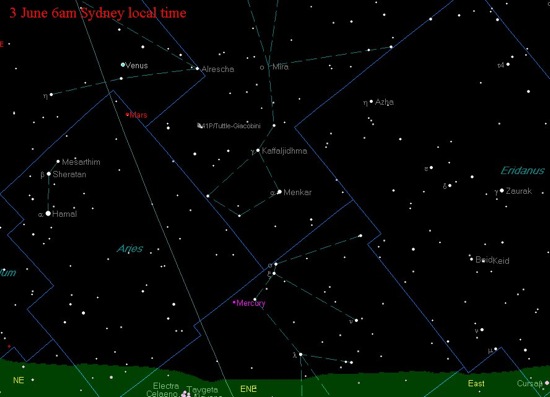
Mercury (near the bottom), Venus and Mars (top left) are in the morning sky this week.
Graphic made using The Sky version 5 http://www.bisque.com/TheSky/
Elusive Mercury should be visible low in the east-north-east sky, about 45 minutes before sunrise. Venus and Mars are well placed close together in the morning eastern sky, with Venus a blazing beacon some five magnitudes brighter than the red planet. Neptune is very close to Jupiter, which should aid in its identification and Uranus is an easy binocular object in Pisces, well up in the morning eastern sky by 3am. The Moon exhibits a waxing, gibbous phase on its way to full on 7 June. Many of the most well known lunar features are on-show this week; see this week’s Solar System round up for the Northern Hemisphere. Observers in the Southern Hemisphere have the significant advantage of the Moon's higher altitude, with more time to make observations and the chance of better seeing conditions.
Comets
There are quite a few moderately bright comets around this week. 2008 T2 (Cardinal), 2007 Q3 (Siding Spring) and 2008 Q3 (Garradd) are all evening objects; 2008 T2 is about 25 degrees above the west-north-west horizon at 6pm, about five degrees north-west of Procyon in Canis Minor. The most recent estimate had it holding steady at magnitude +9. Comet 2007 Q3 is a magnitude +10 object, slightly higher in Monoceros and ten degrees north-east of Sirius. 2008 Q3 (Garradd) is a magnitude +7.5 object, racing through Centaurus and culminating at around 9:30pm. 22P/Kopff is around magnitude +9 and rises around 10:30pm. It is nicely placed in the morning sky, within three degrees of Jupiter and Neptune. 2009 G1 (STEREO) is a fading magnitude +9 morning object that resides in Eridanus, six degrees north of Achernar. Observers will need to get up around 4am to observe it and those with the stamina can also just about catch 2006 W3 (Christensen) as the skies begin to lighten, a brightening magnitude +9 object languishing low over the northern horizon on the Lacerta/Pegasus border.
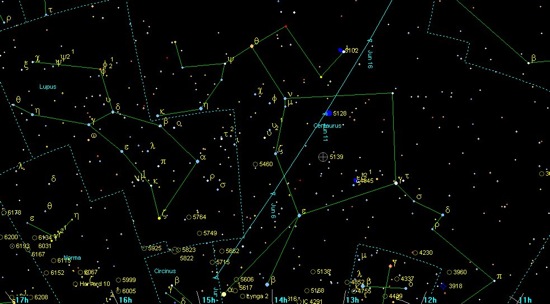
The arrowed path shows Comet Garradd racing through Centaurus in early June.
Graphic made using Megastar version 5 http://www.willbell.com/SOFTWARE/MEGASTAR/index.htm
Deep Sky
|


 SKY CHART