Deep Sky
Abell 12 in Orion
If you're a little jaded imaging or observing all the usual suspects, good as they are, then get those observing juices flowing again by delving deep into the Abell catalogue of planetary nebulae. George Abell was an observer on the Palomar Observatory Sky Survey (POSS) programme and came up with two lists of planetary nebulae (pn) after checking the photographic plates, one in 1955 and one in 1966. Most of these objects are very faint and large telescopes with an OIII filter in most cases will be needed to see them. Dark and transparent skies are mandatory. There are five entries listed in Orion, Abell 10,11,12,13 and 14, but Abell 11 is not a pn but a possible reflection nebula.
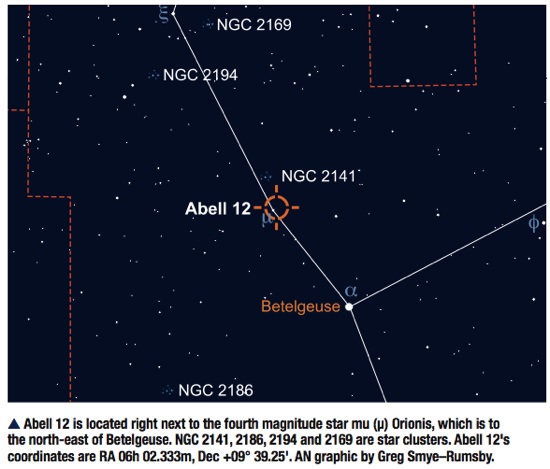

Abell 12 is the best of the four and is easy and hard at the same time; easy to locate, lying right next to the fourth magnitude star mu Orionis, but tough to see due to overpowering glare from mu. If it were somehow possible to relocate this planetary it would not be that tough a proposition as it is not particularly faint, with a photographic magnitude of +13.9. However, it is where it is so observers will have to employ a trick or two to see it. Firstly, use a high a power as is possible in the sky conditions and an OIII filter to help cut don the glare from mu. Owen Brazell reports that he has seen this object with a 200mm scope from these shores and suspects it may be possible to spot it with a smaller aperture. He further comments that it appears as a faint disc with perhaps some brightening at the edges - images do tend to bear this out. Abell 12's proximity to a bright star brings to mind the galaxy NGC 404 in Andromeda, which is close to Mirach (beta And). The observing advice here is to move Mirach out of the field of view before trying to see the galaxy. This is possible as the two are separated by nearly seven arcminutes but Abell 12 is a mere 51 arcseconds from mu Ori, so this is very tough to do. Magnification is the key really and imagers too will need as long a focal length as possible to get the image scale to separate the two.

Double Cluster Sword Handle
There are many sights through the eyepiece guaranteed to thrill but those that outstrip the impact that the Double Cluster in Perseus has can perhaps be counted on only one hand. Here you are getting two for the price of one; two magnificent open clusters side by side which, if placed separately anywhere in the sky, would still be very high on the 'must see' viewing lists of any astronomer. And you don't really need a telescope to enjoy them.

Formally classified NGC 869 and NGC 884, and h and X (chi) Persei, these two open clusters are visible to the naked eye in transparent skies at dark locations, covering about one degree of sky and elongated east-west. Using the famous 'W' asterism in Cassiopeia is perhaps the best signpost to use to locate them. Firstly locate the central star of the five, mag. +2.1 Navi (gamma) and then mag. +2.7 Ruchbah (delta), the next star to the east by about 3.5 degrees. If you move eastwards by roughly another two separations following an imaginary extended line from the two, then you should be there!
The view through binoculars is spectacular, with 10x50s easily resolving most of the member stars, which range from Mag. +7 to +10. Each cluster covers roughly 30 arcminutes across, the same size as the full moon. Switch to a small telescope and the view is stunning; my late colleague, the much-missed Neil Bone loved this object, with his 80mm f/5 refractor's 1.3 degree field of view nicely framing the two clusters. NGC 869, the more westerly of the two has a slightly more concentrated core than NGC 884 and is brighter overall too, with an integrated mag. of +5.3 as opposed to its companion's +6.1.
Both clusters are relatively youthful, thought to have formed out of the same star-forming region some 10-12 million years ago, and probably form the core of the huge Perseus OB1 stellar association. By comparison another marvellous open cluster, the Pleiades or M45 is thought to have formed all of 100 million years ago. Both clusters are remarkably similar too, covering a volume of about 70 light years and weigh in with a reasonably similar mass, with NGC 869 winning out by 3700 solar masses to 2800 for NGC 884. They are moving through space together separated by only a few hundred light years at roughly 7500 light years away. Furthermore, their light is blue-shifted, meaning they are approaching our Solar System.
Constellation of the month: Taurus, the Bull
Taurus is one of the great winter constellations and probably only Orion beats it out in the popularity steaks. Taurus is one of the original 48 constellation figures from the time of the Ancient Greeks by way of Ptolemy's second Century catalogue, the Almagest. Taurus lies on the ecliptic with the Sun resident in June and as such, is one of the twelve classical zodiacal constellations. In Greek mythology, Taurus was associated with Zeus, in the form of a snow-white bull that carried off princess Europa. Taurus is a large constellation covering 797 square degrees (17th largest) and actually borders seven other constellations with the most prominent neighbours being Orion to the south, Auriga and Perseus to the north and Aries to the west.
One notable feature of Taurus is the fact that it's star pattern does resemble the figure it is supposed to represent! If you seek out the bright red star Aldebaran, which the belt of Orion points to 20 degrees or so to its north-west, then the 'V' shaped grouping of stars pointing to the south-west, the Hyades star cluster, represents the head of a charging bull. Aldebaran marks his eye and the two bright stars, beta and zeta, represents its horns. Aldebaran is by far the brightest star in Taurus, coming in at mag. +0.85 and is the 14th brightest star in the sky. It also has the honour of being the brightest star that can be occulted by the Moon; the next series of occultations begin in 2015. It is a K5 giant thought to be 1.7 times as massive as the Sun and lies 67 light years away. This places it at about half the distance of the sprawling Hyades open cluster.

The Hyades cluster is the second closest cluster to our Solar System at 150 light years away. It contains around 200 stars and most members are concentrated in an area some 15 light years across. On the sky the Hyades span an area 5.5 degrees across and as such binoculars are the instrument of choice for observing it, just nicely fitting into the field of 10x50?s. Whilst admiring the cluster, take a bit of time out to observe the wide double star theta Tauri, a true binary star with components of A- and K- class giant stars shining at mag. +3.4 and +3.8, separated by 5.6 arcminutes. As a member of the Hyades this separation equates to a quarter of a light year at the clusters distance. Staying on the star theme, the 'V' points directly to the variable star lambda Taurii, an eclipsing binary similar to Algol in Perseus. The lambda system comprises an A-class star 'secondary' orbiting a brighter B-class primary and when the latter is eclipsed by the former we see the combined mag. fade from its normal +3.4 to +3.9 every 3.95 days.
Taurus contains two Messier objects and great ones they are too. M45 is a great open cluster and is most commonly known as The Pleiades and less so The Seven Sisters. The Pleiades is the easiest of all Messier objects to see with the naked eye and it is by far the finest open star cluster to observe with the naked eye. It is also one of the closest clusters to us at 425 light years distance, which accounts for much of its brilliance - it has an integrated magnitude of +1.5, with the brightest Pleiad, Alcyone, shining at mag. +2.9. The Pleiades is thought to have around 200 true members spread over two by two degrees, with another possible 130 or so spread over a nine by nine degree field. Depending on which stars can confirm their membership the cluster could have an actual diameter of anything from 15 to 70 light years. It is thought to be around 100 million years old. The Pleiades has been known since prehistoric times and it gets a mention in Homer's Odyssey and the Old Testament.
To the naked eye M45 appears similar to the Plough asterism confined to a two-degree wide field, four times that of a full moon - many observers will be surprised it is that big! How many cluster stars you can see will depend on many factors such as eyesight, light pollution and sky conditions on the night but generally six bright stars are seen, with as many as 10 from dark locations. Binoculars or a small telescope operating at low power are the best options for observing M45 and digital images will produce spectacular results.
Messier 1, The Crab Nebula, is another splendid object despite it not being visible with the naked eye. M1 is a supernova remnant (SNR), the chaotic remains of a massive star, which blasted apart in 1054 and was a naked eye and even a daylight object for a short while. It is the brightest SNR in the sky at mag. +8.4. M1 is probably the most intensely studied deep sky object in our Galaxy, as it is so young and close, only 6200 light years distance. The pulsar at the centre of the Crab attracts much of the attention and it was the first to 'give up' an optical counterpart, the 16th magnitude star designated CM Tauri. Amateurs can readily image it.
M1 is not an easy object for small 'scopes and is barely visible in 10x50 binoculars. If you have a 80-100mm scope it should show an oval glow spanning around 5x3 arcminutes but even a 300mm will struggle to show hints of the filamentary structure so familiar to us from the countless images now available in print and on-line. At least it is easy to find with the obliging mag. +3 star zeta Tauri, the star marking the Bull's more southerly horn, placed a mere one degree to the Crab's south-east.
In the northern regions of Taurus, close to the border with Perseus and 3.5 degrees south-east of third magnitude zeta Persei lies the pretty but tricky planetary nebula NGC 1514. Spanning just over two arcminutes and glowing at mag. +11, this planetary needs a moderate to large 'scope to observe it well; at least a 200mm aperture would be good. At least the mag. +9.4 central star is an easy object and it will remain visible with the surrounding nebula when viewed through an OIII filter.
There are a couple of really challenging objects in Taurus for owners of light-bucket apertures observing under dark, transparent skies. Simeis 147 is another SNR like M1 but it is larger and much, much fainter; maybe it is beyond the reaches of observers under less than favourable UK skies. This might still be the case for the aforementioned light buckets but go for it if you have at least a 500mm 'scope on an exceptional night. Wide-field imagers will have much more luck and there are many fine images out there of this ancient SNR, thought to be around 100,000 years old and reaching the end of its life before dispersing.
Hinds Variable Nebula, NGC 1555 is one of a small group of nebulae surrounding young, energetic stars that perceptively vary in appearance over short time scales. The most famous example is Hubble's in Monoceros and amateur images clearly show variability in the structure. Hinds is a much tougher prospect for both imagers and visual observers - it is only 30-40 arcseconds in diameter and at least a 250-300mm aperture will be required just to see it. The driving force behind this nebula is variable star T Tauri, the prototype of the so-called 'nebular variables' - very young stars associated with their birthing nebulosity.
Use these coordinates to help you track down the highlights of Taurus:
M45 (Pleiades) |
RA: 03h 47m 28.6s |
Dec: +24º 06' 19s |
lambda |
RA:04h 01m 19.6s |
Dec:+46º 13' 16s |
NGC 1514 |
RA:04h 09m 16.9s |
Dec:+46º 13' 16s |
NGC1555 (Hinds) |
RA:04h 22m 54.0s |
Dec:+19º 32' 00s |
Hyades |
RA:04h 27m |
Dec:+16º 50' |
Aldebaran |
RA:04h 35m 55.2s |
Dec:+16º 30' 33" |
M1 (Crab) |
RA:05h 34m 32.0s |
Dec:+22º 00' 52" |
Simeis 147 |
RA:05h 39m 00.0s |
Dec:+28º 00' 00 |
Solar System Round-Up
|