|
|
|

|
|
|
Posted: 05 December, 2008 The launch of NASA's Mars Science Laboratory has slipped to 2011, two years after the original schedule, in order to allow further hardware testing to ensure a maximum science return. "We will not lessen our standards for testing the mission's complex flight systems, so we are choosing the more responsible option of changing the launch date," says Doug McCuistion, director of the Mars Exploration Program at NASA Headquarters in Washington. "Up to this point, efforts have focused on launching next year, both to begin the exciting science and because the delay will increase taxpayers' investment in the mission. However, we've reached the point where we can not condense the schedule further without compromising vital testing."
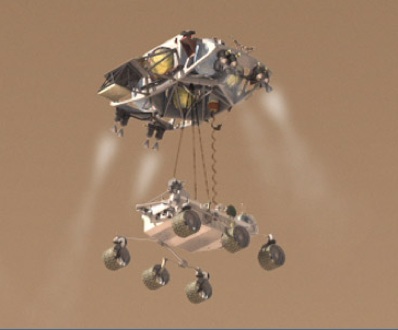
Mars Science Laboratory will be lowered to the Martian surface by a new sky-crane technology. Image: NASA/JPL-Caltech. Since the optimal window for a launch to Mars occurs for just a few weeks every two years, the mission will be put back to a launch in the autumn of 2011. "The right and smart course now for a successful mission is to launch in 2011," says Charles Elachi, director of NASA's Jet Propulsion Laboratory. Mars Science Laboratory is a next generation rover with a suite of advanced research tools ten times the mass of those on the Spirit and Opportunity rovers, that will allow scientists to study the early environmental history of Mars in better detail than ever. One of the four candidate landing sites under consideration will be chosen later next year, and will enable the rover to check for evidence of whether ancient Mars environments had conditions favorable for supporting microbial life and preserving evidence of that life if it existed there. The advanced rover is also one of the most technologically challenging interplanetary missions ever designed. It will use new technologies to adjust its flight while descending through Rigorous testing of components and systems is essential to develop such a complex mission and prepare it for launch. Tests during the middle phases of development resulted in decisions to re-engineer key parts of the spacecraft. "Costs and schedules are taken very seriously on any science mission," says Ed Weiler, associate administrator for NASA's Science Mission Directorate. "However, when it's all said and done, the passing grade is mission success." |
|
|
|
||||||||||||||||||||||||||||||||||||||||||