|
|
|

|
|
|
After more than 17 years dedicated to exploring the effects of solar activity on the space that surrounds us, the sun is setting on the Ulysses mission and will finally fade into darkness on July 1, but its legacy will live on. Hurtling through space at an average speed of 56,000 kilometres per hour, the pioneering joint ESA-NASA Ulysses mission has logged over 8.6 thousand million kilometres during its 17.5 year loop the loop of the Sun and Jupiter, withstanding some of the most extreme conditions in the Solar Systems and surpassing all expectations of an originally proposed 5 year mission.
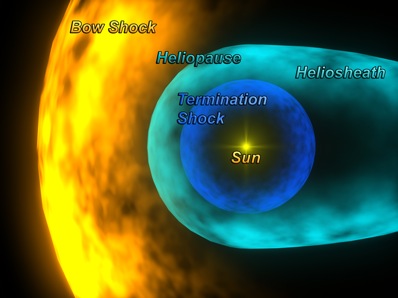
The heliosphere is a big magentic 'bubble' in space carved out by the solar wind. It defines the sphere of influence of the Sun and extends well beyond the furthest fringes of the Solar System. Image: ESA (C. Carreau). Ulysses was designed to explore uncharted territories of our Solar System, including the regions above and below the Sun’s poles, and to study our star’s heliosphere, the vast bubble in space carved out by the solar wind that separates the solar neighbourhood from the interstellar medium. The reams of data Ulysses has returned have forever changed the way scientists view the Sun and its effect on the space surrounding it. The Sun emits a constant stream of particles – the solar wind – which the magnetic field carries through space. Because the Sun rotates, scientists believed that the magnetic field would wind up into a spiral. However, Ulysses showed that the actual magnetic field is much more complex in shape and extent, allowing particles emitted by solar storms at low latitudes to climb up to higher latitudes, and vice-versa. This was an extremely important discovery, as regions of the Sun not previously considered as possible sources of hazardous particles for astronauts and satellites must now be taken into account and carefully monitored.
Pre-Ulysses, it was thought that the speed of the solar wind was relatively weak, with sporadic high speed gusts. Ulysses soon showed that for much of the sunspot cycle, it has a dominating fast wind emitted from the solar magnetic poles, and a lesser slow wind. Thanks to the fleet of solar observing spacecraft that have been monitoring the Sun over the last decade, scientists now know that the top speed of the solar wind can reach 2.7 million kilometres per hour, which emanates from polar regions, with a slower wind of about half that originating from equatorial regions. When the Ulysses mission was extended beyond the original goal of one orbit of the Sun, scientists were able to watch how the solar wind changed with time, and found that the emission varies through a cycle of magnetic activity lasting approximately 11 years, culminating in the reversal of the magnetic field direction. “We designed the mission to give us a 3D view of the solar wind, but we got the fourth dimension of time, as well,” says Richard Marsden, ESA Ulysses Project Scientist.
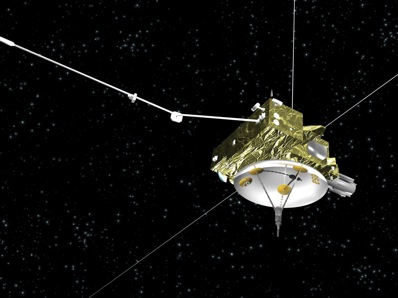
Artist impression of the Ulysses spacecraft flying in space. Image: ESA (C.Carreau). Ulysses also showed that the heliosphere could be invaded by dust from deep space, and found 30 times more dust from deep space in the vicinity of the Solar System than astronomers had previously expected. The hardy spacecraft also detected heavy atomic nuclei, or cosmic rays, racing into the Solar System having been accelerated by the explosion of high-mass stars. Ulysses estimated that the average age of a cosmic ray entering the Solar System is 10-20 million years and they have spent their lives streaming through the Galaxy’s outer regions before finding their way into the Solar System. Ulysses also collected rare samples of interstellar helium isotopes. These are especially interesting to cosmologists because theory predicts that their abundance was more or less fixed within a few minutes of the Big Bang. Ulysses measured these isotopes, finding evidence to support the idea that the Universe will expand forever because insufficient matter was created in the Big Bang to halt its outward march.
Over the next couple of weeks Ulysses will gradually cease to function because of the decline in power produced by its onboard generators, and while engineers have come up with ingenious ways of conserving energy over the last few years, the power has finally dwindled to the point where fuel will soon freeze in the spacecraft’s pipelines. "When the last bits of data finally arrive, it will surely be tough to say goodbye to Ulysses," says Nigel Angold, ESA’s Ulysses Mission Operations Manager. "But any sadness I might feel will pale in comparison to the pride of working on such a magnificent mission. Although operations will be ending, scientific discoveries from Ulysses data will continue for years to come." Around 200 scientists have worked on the Ulysses instrument teams, and around 1,500 peer reviewed papers have been published so far using Ulysses data. Scientists will continue to wring out every drop of data from the mission ensuring that the legacy of Ulysses will live on long after the actual spacecraft has died.
For the most up to date picture of the Sun, be sure to get your copy of the July issue of Astronomy Now magazine, which includes an 11-page focus on our very active star.
|
|
|
|
||||||||||||||||||||||||||||||||||||||||||||