

|
|
|
   |
|
BP Piscium's identity crisis DR EMILY BALDWIN ASTRONOMY NOW Posted: 15 September 2010 
A star that displays a gaseous disc and a pair of jets blasting out of it, typical characteristics of a young star, could in fact be more evolved than our own Sun. 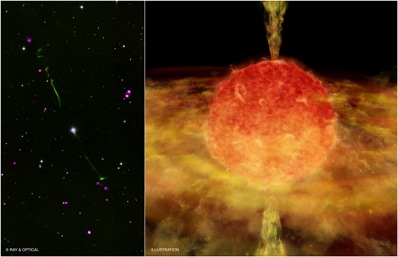 Left: X-ray (Chandra; purple) and optical (Lick Observatory; orange, green and blue) data of BP Psc clearly shows the jets bursting from the system. Right: Artist's impression of BP Psc close-up, showing its dusty disc. Image: X-ray (NASA/CXC/RIT/J.Kastner et al), Optical (UCO/Lick/STScI/M.Perrin et al); Illustration: NASA/CXC/M.Weiss. BP Piscium (BP Psc), located in the constellation of Pisces, has been studied for over a decade, but its somewhat curious characteristics have made its history difficult to interpret. Its dominating features – a dusty and gaseous disc of material around it and a pair of jets several light years long blasting out of the star in opposite directions – are typical of youthful stars. But new results suggest it could be a one billion year old red giant star. In this scenario the disc and jets could be interpreted as remnants of a recent interaction. That is, as BP Psc swelled up at the end of its main sequence life, its extended atmosphere engulfed a nearby star or giant planet. “It appears that BP Psc represents a star-eat-star Universe, or maybe a star-eat-planet one,” says Joel Kastner of the Rochester Institute of Technology, who led the study using Chandra X-ray Observatory data. “Either way, it just shows it’s not always friendly out there.” The re-evaluation comes from three key pieces of evidence. First, BP Psc is a loner – it is not located near a star-forming cloud, and has no young neighbours. Second, only a small amount of lithium is detected in its atmosphere (a characteristic of elderly stars) and third, the star's surface gravity is too weak for a young star and is much better matched to an old red giant. New Chandra X-ray data supports the idea that BP Psc is an old star. In X-rays, young, low mass stars are brighter than older stars, and the X-rays from BP were detected at a rate too low for a young star. Instead, the data is consistent with a rapidly rotating giant star, and its spectrum indicates surface flares, or interactions between the star and disc. “The last piece of evidence, which, to me, is the nail in the coffin that BP Psc is old rather than young, is that its rate of X-ray production is very similar to old, yet rapidly spinning, giant stars that have surface temperatures similar to BP Psc,” says Kastner. If BP Psc were a young star, it would emit X-rays in the hundreds, even up to a few thousand, in a day’s observing time with Chandra. “We stared at BP Psc for one day with Chandra and only detected about 18 X-rays.” All the evidence points to BP Psc having swallowed a companion. “These giant stars’ companions have fallen inside and spun them up,” explains Kastner. “But we’ve never actually caught one in the act. I think BP Psc is an example of such an interaction. Our working speculation is that we are observing the star right at the point at which it has swallowed its companion and hence formed a disc. Some of the material that used to be its companion has fallen onto the star and some has been shot out at high speeds, and that’s what we’re seeing.” Furthermore, there is speculation that the dusty debris disc could spawn a second generation of planets, hundreds of millions of years since a possible first batch may have existed, but then consumed by the star. BP Psc will provide astronomers with important details of how this process might occur. A similar fate is expected for the Earth when the Sun reaches the end of its main fuel-burning life in several billion years time. “BP Psc shows us that stars like our Sun may live quietly for billions of years,” says co-author David Rodriguez from UCLA, “but when they go, they just might take a star or planet or two with them.” |
|
|
|
|