Hubble's Saga
BY ADRIAN BERRY
Posted: July 9, 2008
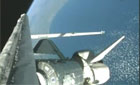
AFTER the Hubble Space Telescope has been repaired this autumn and been given its new wide field camera to view the distant universe, many astronomers believe it will enter its period of greatest glory.
Yet it very nearly didn't happen. But for the most unimaginable good luck and good management over many years there might have been no space telescope, and the sky might still be as mysterious to us as before it flew.
The telescope seemed always on the brink of termination, as reported in a remarkable new book by Robert Zimmerman, The Universe in a Mirror: The Saga of the Hubble Space Telescope and the Visionaries who Built it (Princeton University Press).
The whole enterprise seemed to follow an even rockier course than Arthur C. Clarke said tended always to bedevil big enterprises. Before outlandish ideas become reality, he suggested, they provoked three stages of reaction. First, "It's completely impossible." Second, "It's possible but not worth doing." Third, "I said it was a good idea all along."
In the 1940s and 1950s, the telescope's "father'' Lyman Spitzer couldn't get anyone interested in the idea. Then he was told that the task was too difficult technologically and should be scrapped.
In the 1970s the idea was at last accepted but faced repeated attempts to cancel it. Congress tried to do so in 1974. Two years later NASA tried. Even during construction in the 1980s, budget problems almost killed the telescope several times. Then, in 1990, when it was finally up in space, it was yet again almost scrapped when its mirror was found to be warped and could not focus.
Hubble's travails continued into the next century. After the Columbia accident of 2003, the bureaucratic, bumbling and self-confessed "bean counter'' NASA administrator Sean O'Keefe, refused to let it be repaired by astronauts because of his obsessions with cost and risk. But he resigned after a blizzard of protest greeted his decision, and NASA's new administrator Michael Griffin announced that the repair mission would go ahead.
It is an extraordinary saga, and it does seem that the objections to Hubble – and its successors – have been antiquated and ridiculous. True, it costs 30 to 100 times more to put a telescope in space than its does to put one on top of a mountain, but there are massive compensating advantages.
It is possible to see things in space that cannot be seen from the ground because they are blocked by the atmosphere. Down here, entire wavelengths of the spectrum are invisible. And objects can be examined at far greater detail because the possible angular resolution is far greater in space. (On the ground it is limited to between a half and one arc seconds. From Hubble, at 375 miles above Earth, it is 0.05 to 0.1 arc seconds.)
My fear is that some future space telescopes are going to be placed so far away from Earth that it will be too difficult for astronauts to visit them and make repairs. Human supervision of such complicated machines seems vital. This autumn's will mark the fourth visit to Hubble by astronauts. Had these repair trips not been possible, or if they had been left to robots, the Hubble telescope would long ago have died.
One of the most promising of all space telescope projects will be those that will be placed on the Moon. One day, when we have returned to the Moon, people will have continuous access to these instruments, make them safe from decay and destruction.
Previous Adrian Berry

Jun Be Prepared! read more
May The Unknowable read more
Apr Time Without End read more
Mar Ugly Light read more

Visit Adrian Berry's website at www.adrianberry.net He is Consulting Editor (Science) of the Daily Telegraph.
|