|
|
|
   |
|
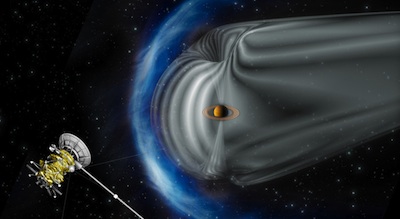
Cassini sheds light on cosmic particle accelerators NASA PRESS RELEASE Posted: 19 February 2013 During a chance encounter with what appears to be an unusually strong blast of solar wind at Saturn, NASA's Cassini spacecraft detected particles being accelerated to ultra-high energies. This is similar to the acceleration that takes place around distant supernovas.
Shock waves are commonplace in the universe, for example in the aftermath of a stellar explosion as debris accelerate outward in a supernova remnant, or when the flow of particles from the sun - the solar wind - impinges on the magnetic field of a planet to form a bow shock. Under certain magnetic field orientations and depending on the strength of the shock, particles can be accelerated to close to the speed of light at these boundaries. These may be the dominant source of cosmic rays, high-energy particles that pervade our galaxy. Scientists are particularly interested in "quasi-parallel" shocks, where the magnetic field and the "forward"-facing direction of the shock are almost aligned, as may be found in supernova remnants. The new study, led by Adam Masters of the Institute of Space and Astronautical Science, Sagamihara, Japan, describes the first detection of significant acceleration of electrons in a quasi-parallel shock at Saturn, coinciding with what may be the strongest shock ever encountered at the ringed planet. "Cassini has essentially given us the capability of studying the nature of a supernova shock in situ in our own solar system, bridging the gap to distant high-energy astrophysical phenomena that are usually only studied remotely," said Masters. The Cassini-Huygens mission is a cooperative project of NASA, ESA and ASI, the Italian space agency. NASA's Jet Propulsion Laboratory, a division of the California Institute of Technology in Pasadena, manages the mission for NASA's Science Mission Directorate, Washington. |
|
|
|
||