|
|
|
   |
|
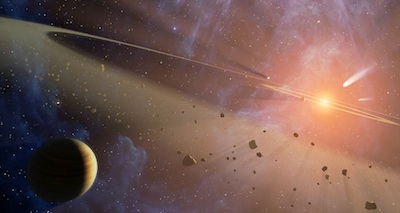
Comets crash every 6 seconds around nearby star BY KEITH COOPER ASTRONOMY NOW Posted: 15 November 2012 Comets are smashing into each other with a collision every six seconds around a star 200 light years away, say astronomers in the United States.
Now Zuckerman, along with Inseok Song of the University of Georgia, has determined the startling explanation. Trillions of comets, each one several kilometres across, are believed to form a giant Kuiper Belt of icy bodies encircling the outer fringes of the 49 Ceti system. The comets are densely packed, each separated by just 140,000 kilometres. Every time one comet crashes into another, the collision releases carbon monoxide gas. To supply the observed amount of gas, there must have been a comet collision every six seconds for over ten million years. "I was absolutely amazed when we calculated this rapid rate," says Zuckerman. "I would not have dreamt it in a million years." While this rapid rate of comet collisions does seem hard to comprehend, Zuckerman and Song are confident in their analysis, based on an estimate of the age of 49 Ceti from a group led by Carlos Torres of the Laboratorio Nacional de Astrofisica in Brazil. The star is part of a moving group of stars called the Argus Association, which all formed at the same time, allowing easier age measurements. While it is possible that 49 Ceti could just happen to lie in the way of this group and be in fact a different age, Zuckerman says the chances of this are low. He estimates that 49 Ceti's Kuiper Belt contains 400 Earth-masses worth of comets, compared to the 0.1 Earth masses worth of icy bodies in our Solar System's Kuiper Belt. However, models of how our Solar System formed and evolved predict that there there used to be 100 times more material in our Kuiper Belt, but this is still dwarfed by those of 49 Ceti and HD 21997, another local star found to have an overabundance of carbon monoxide in a disc around it. "In our model, based both on the presence of the CO molecules and on the large amount of dust relative to the amount that orbits other young stars, 49 Cet and HD 21997 have among the most massive comet clouds in the solar vicinity," Zuckerman tells Astronomy Now. "Somebody has got to be the heavyweights and these two appear to be near the top; they are a bit like the tip of the iceberg." Consequently, Zuckerman is looking forward to searching other nearby stars for carbon monoxide discs using the Atacama Large Millimetre/sub-millimetre Array (ALMA) in Chile. "I'm guessing that when a powerful new radio telescope such as ALMA is pointed at other very dusty young stars in the solar vicinity that many of them will also reveal large quantities of carbon monoxide molecules released by comet collisions," says Zuckerman. "We have submitted a request to do such a search with ALMA." |
|
|
|
|